How to build a knowledge transfer checklist that actually works
A knowledge transfer checklist is one of the simplest, highest-value tools a mandated team can have. It protects against knowledge loss, speeds up transitions, and gives new hires the critical information they need to contribute faster.
A knowledge transfer checklist is one of the simplest, highest-value tools a mandated team can have. It protects against knowledge loss, speeds up transitions, and gives new hires the critical information they need to contribute faster.
Most teams don't think about knowledge transfer until someone hands in their notice.
Suddenly, there's a scramble. A rushed handover doc. A few overlap sessions. A shared drive folder that nobody will ever find again. And a new hire, or a stretched team, left to piece it together.
A knowledge transfer checklist solves part of that. But filling it in isn't the same as transferring knowledge. Knowledge sitting in a document is knowledge in storage, and storage isn't the same as transfer. It still has to reach the people who need it, in a format they can actually learn from.
This guide covers everything you need to build a knowledge transfer checklist that works and what to do with it once it's filled in.
- What a knowledge transfer checklist is (and what it isn't)
- When you actually need one
- What to include, with a ready-to-use template
- Best practices for making knowledge transfer stick
What is a knowledge transfer checklist (and what it isn't)
A knowledge transfer checklist is a structured document that captures the critical knowledge, processes, contacts, and context someone holds in their role, so it doesn't disappear when they leave or transition.
But it's not:
- A substitute for proper knowledge transfer documentation
- A one-time offboarding task
- The same as dropping files into a shared drive
Most checklists focus on explicit knowledge: the processes and tools that are easy to write down. The harder part is capturing tacit knowledge: the judgment calls, unwritten rules, and institutional expertise that live in someone's head.
That's the real gap a good checklist is designed to close.
One more distinction. A checklist captures knowledge. But knowledge sharing doesn't end when the document is filled in. A new hire reading a 10-page Word doc isn't the same as one who's worked through structured training built from that content.
The checklist is the foundation of your knowledge transfer plan, not the whole building.
When do you actually need a knowledge transfer checklist
Not just when someone quits. Here are the three moments that matter most.
Onboarding a new employee
A knowledge transfer checklist isn't only for the person leaving. It's equally valuable for the person arriving.
A well-built checklist becomes the foundation of a new hire's first 30-60-90 days. It gives them role clarity, key contacts, and process context from day one. For fast-moving teams, this matters immediately. Every week a new hire spends piecing things together is a week of lost momentum.
Knowledge transfer to a new employee works best when it's proactive, built before the need becomes urgent.
If you're onboarding a new sales rep, thisSales Rep Onboarding: Foundations for Success course template (built with Coassemble) is a ready-to-use starting point you can copy and customize for your team.
Employee offboarding and role transitions
The most obvious use case. When someone exits (resignation, retirement, or internal move), the checklist ensures critical knowledge doesn't leave with them.
The earlier you start, the better. Waiting until the final week is too late. By then, knowledge gaps are already forming, and there's no time to close them properly.
Cross-team knowledge sharing and internal promotions
When responsibilities shift between departments or when a team scales quickly, siloed knowledge stays siloed without a system to move it.
A few situations where this comes up constantly in fast-moving companies:
- A product ops team documenting processes before a key engineer moves to a new squad
- A customer success lead briefing the support team before a product launch
- Senior ICs preparing to transition into management
Without a structured knowledge transfer plan, the same institutional knowledge gets rebuilt from scratch every time. That's not a knowledge-sharing culture; that's a knowledge loss problem dressed up as normal.
What to include in a knowledge transfer checklist
This is the section that does the heavy lifting. A robust knowledge transfer plan covers more than active projects and login credentials. Here's what to capture.
Role overview and responsibilities
Start with what the person actually does: not the job description, the real version.
- What decisions do they own?
- What do they get pulled into that isn't formally documented anywhere?
- What does a typical week actually look like?
This is the critical context a new person needs to hit the ground running.
Active projects and ongoing tasks
Document what's in flight right now.
- What's active, on hold, or blocked?
- What has a hard deadline coming up?
- What's waiting on someone else?
This is often the most urgent piece during any transition.
Key contacts (internal and external)
Not just names. Context.
- Who does this person rely on daily?
- Which vendors, clients, or stakeholders matter most?
- How do those relationships actually work?
Key knowledge areas like this are easy to overlook and expensive to rebuild.
Processes, systems, and tools
This is where most of the tacit knowledge lives.
- Step-by-step workflows and standard operating procedures
- Tool access and logins to hand over
- The "how we actually do things here" that never makes it into official documentation
Implicit knowledge (the shortcuts, workarounds, and muscle memory built over months) belongs here too.
Institutional context and lessons learned
The hardest to capture. The most valuable to keep.
- Why was a decision made a certain way?
- What's been tried and didn't work?
- What are the unwritten rules?
Insights gained from experience don't transfer automatically. Make space for them explicitly or they're gone.
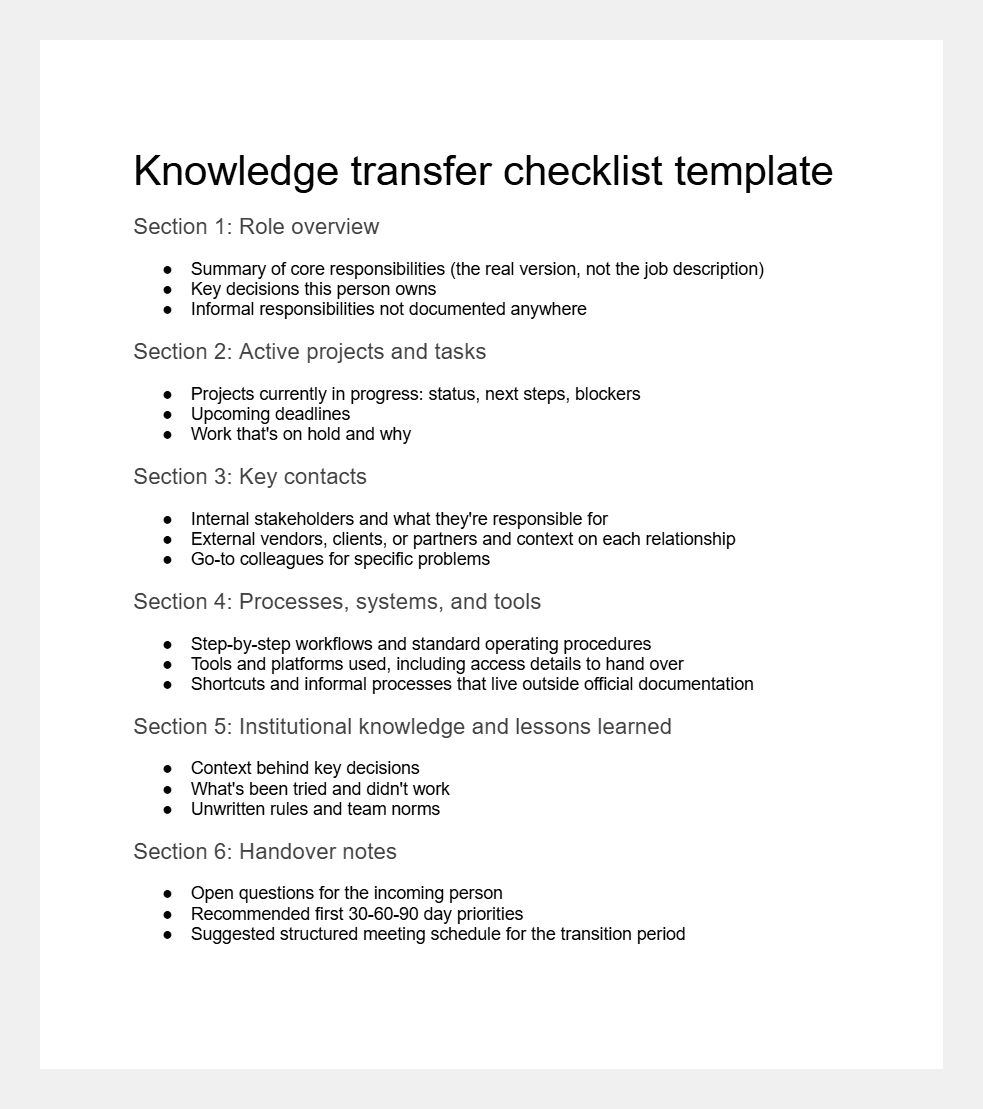
A knowledge transfer checklist template (ready to use)
A good knowledge transfer template gives your team a consistent, repeatable starting point. Use this one as-is or adapt it to fit the complexity of the role. Here’s the template:
Section 1: Role overview and responsibilities
- Summary of core responsibilities (the real version, not the job description)
- Key decisions this person owns
- Informal responsibilities not documented anywhere
Section 2: Active projects and tasks
- Projects currently in progress: status, next steps, blockers
- Upcoming deadlines
- Work that's on hold and why
Section 3: Key contacts
- Internal stakeholders and what they're responsible for
- External vendors, clients, or partners, and context on each relationship
- Go-to colleagues for specific problems
Section 4: Processes, systems, and tools
- Step-by-step workflows and standard operating procedures
- Tools and platforms used, including access details to hand over
- Shortcuts and informal processes that live outside official documentation
Section 5: Institutional knowledge and lessons learned
- Context behind key decisions
- What's been tried and didn't work
- Unwritten rules and team norms
Section 6: Handover notes
- Open questions for the incoming person
- Recommended first 30-60-90 day priorities
- Suggested meeting schedule for the transition period
[👉 Download the free template here. To save a copy, go to File > Download and choose your preferred format.]
From documentation to training in minutes
Filling in the template is step one. But knowledge transfer documentation that sits in a Google Doc is still knowledge in storage.
This is where Coassemble changes the equation.
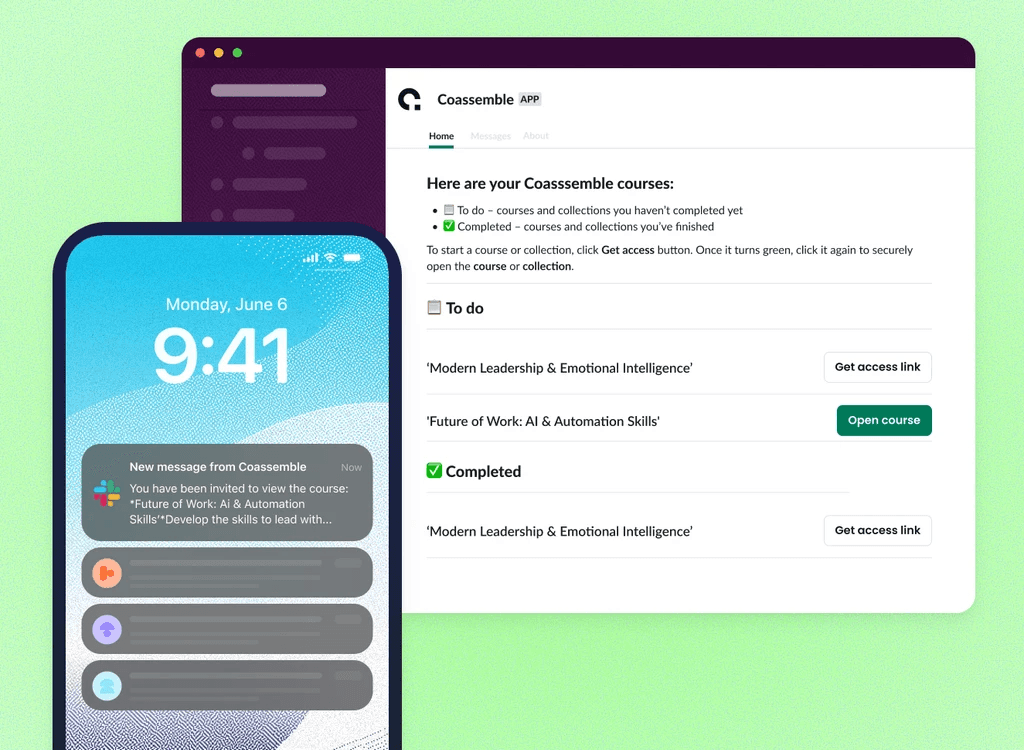
A team lead takes the completed checklist, builds it into a course in minutes, and publishes it as a branded, trackable walkthrough the new hire works through at their own pace.
And because Coassemble connects with Slack, the training gets shared directly in the relevant channel (where the team already works) rather than buried in a shared drive.
That's the difference between knowledge in storage and knowledge in motion.
Not sure which tools support the process? Here's a breakdown of the best knowledge transfer tools for fast-moving teams.
Best practices for making knowledge transfer actually work
A checklist gives you structure. These practices make the knowledge transfer process actually stick.
Start before you need to
The best time to build a structured and effective knowledge transfer plan is when nothing is changing. Make it part of regular team rhythms, not something that only happens in crisis mode. Employee turnover is unpredictable. Your system shouldn't be.
Separate explicit knowledge from tacit knowledge
Processes are easy to document. Judgment, critical context, and relationships are harder, but far more valuable. A robust knowledge transfer plan makes space for both. Don't let implicit knowledge get skipped because it's difficult to write down.
Make it a two-way conversation
The person transferring knowledge shouldn't fill in the checklist alone. A structured meeting, even just 30 minutes, surfaces critical knowledge areas that never make it into written documentation. Encourage open communication between knowledge holders and incoming team members. That's where the real knowledge exchange happens.
Format for the person receiving it
A checklist built around the departing employee's role isn't the same as one built for the new person's learning preferences. Effective knowledge transfer means organizing content around how the receiver needs to learn it, not how it was easiest to write.
Deliver it where work already happens
Knowledge transfer fails when it lives outside daily workflows. Use Coassemble to turn documented knowledge into training that gets shared directly in Slack, so it reaches team members in the tools they're already in, rather than a platform they have to remember to log into. That's what drives real knowledge retention and builds a knowledge-sharing culture, not just a knowledge base.
Build in feedback loops
Knowledge transfer documentation goes stale fast. Build in regular review cycles. Collect user feedback from new hires after their first 30 days. Use performance metrics and actionable insights to identify knowledge gaps and drive continuous improvement across your key knowledge areas.
For a deeper look at how to structure this, see our guide to building a knowledge management strategy.
Where the checklist ends and transfer begins
A knowledge transfer checklist is one of the simplest, highest-value tools a mandated team can have. It protects against knowledge loss, speeds up transitions, and gives new hires the critical information they need to contribute faster.
But the checklist is only the beginning.
Knowledge documented is not the same as knowledge transferred. The teams that close that gap treat knowledge transfer as a living system, not a one-off task triggered by someone's resignation. They capture explicit and tacit knowledge. They build a structured knowledge transfer plan before they need one. And they deliver it where work already happens.
Your team already has the knowledge. Coassemble helps you move it: from checklist to course, from shared drive to Slack, from stored to used.
FAQs on knowledge transfer checklist
What should be included in a knowledge transfer checklist?
A strong checklist covers role responsibilities, active projects, key contacts, processes and tools, and institutional knowledge. Include tacit knowledge, the judgment calls and unwritten rules, not just explicit processes.
What is the difference between a knowledge transfer checklist and a knowledge transfer plan?
A checklist captures what someone knows. A knowledge transfer plan defines how that knowledge gets shared, with whom, and by when. The checklist feeds the plan.
How do you do a knowledge transfer to a new employee?
Start with a completed checklist, then turn it into structured training. A new hire working through trackable, interactive content learns faster than one reading a static document.
When should you start a knowledge transfer?
Before you need to. Build knowledge transfer into regular team rhythms so it's ready when personnel changes happen, not scrambled together after someone resigns.
How do you capture tacit knowledge during a knowledge transfer?
Make it a conversation, not a solo task. A structured handover session surfaces the context, judgment, and lessons learned that never make it into written documentation.
Keep reading
The cost of poor internal knowledge management: statistics that make the case
Poor knowledge management doesn't announce itself. It doesn't show up as a line item. It shows up as a new hire still piecing things together six weeks in. A product update that never made it past a Slack thread. A process question answered differently every time someone asks.
Tools for knowledge management: from storage to structured training
Stored knowledge isn't transferred knowledge. A wiki doesn't guarantee your team can execute what's in it. Knowledge bases don't track who actually learned the material.
How to build self-directed training your team will actually use
Self-directed training is all about giving teams the tools to move what they already know into something the whole business can use.