The LMS is no longer enough: The shift toward embedded learning
Learning platforms can deliver and track content well — but today's teams expect more. They want to create interactive learning inside the systems they already use. This guide explores how embedded e-learning turns an LMS from a delivery tool into a complete learning ecosystem.
Building your own course creation tools takes years and a serious engineering budget. Most product teams don't have either to spare. So they bolt on a traditional platform that never quite fits their stack, or push users out to a separate tool entirely.
Embedding course creation into your LMS solves this differently. Instead of building authoring infrastructure from scratch, teams add it through an API. Content gets created, teams embed videos, and courses launch directly inside the platform.
In this article, we'll explore:
- What it means to embed e-learning in an LMS
- How it works in practice
- How Coassemble Embed powers AI-driven knowledge transfer to improve what your platform already does best
Why do traditional LMS platforms need to be updated?
Most learning management systems (LMS) handle the basics well: enrolments, progress tracking, reporting. But interactive content creation still happens somewhere else.
That handoff costs you. Content leaves the platform, gets rebuilt in a separate authoring tool, and comes back as a static file:
- Every update means another export.
- Every export means another upload.
- Every upload risks version confusion for learners.
For platform owners, this gap is strategic, not cosmetic. When users build content elsewhere, they spend less time inside your product. Retention weakens and perceived value drops.
The SCORM export-and-upload cycle was built for a different era, when courses lived in files rather than connected systems. A creator built the course externally, exported the package, and uploaded it. That process still works well for portability today, but it's slow as the only way to keep content current.
How does embedded e-learning work in an LMS?
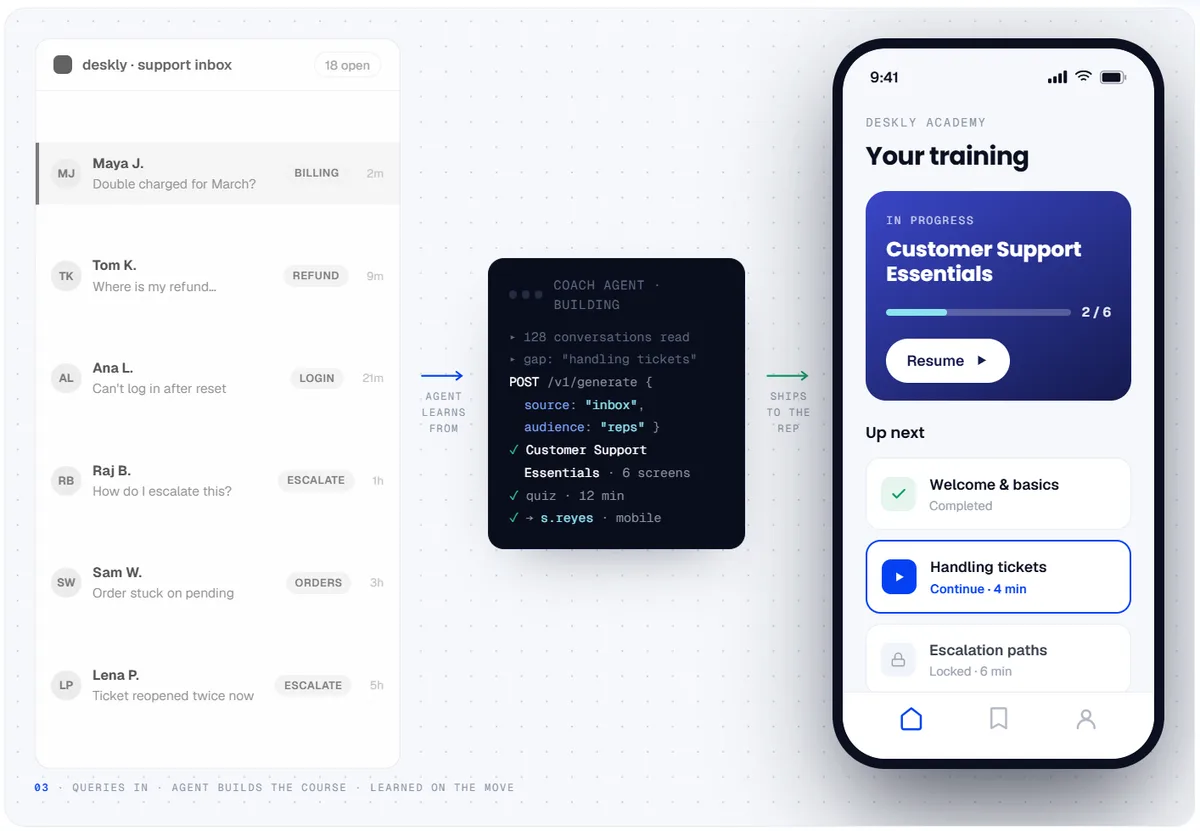
Embedded e-learning connects creation to delivery inside your existing platform. Instead of managing files and packages, an API-first engine powers course creation and supports tracking directly within your product.
Coassemble Embed works this way. Your platform controls the interface and the experience. Coassemble's API and embeddable components handle the authoring, tracking, and delivery layer underneath:
- Course and collection players, for learners to view and complete content
- Course and collection builders, for authors creating and editing directly inside your platform
- Analytics dashboards, for tracking progress without leaving your product
Nothing gets exported and re-uploaded. Your content stays live, connected, and instantly updatable, right where your users already work.
Explore the embeddable components →
Why do LMS platforms need embedded e-learning?
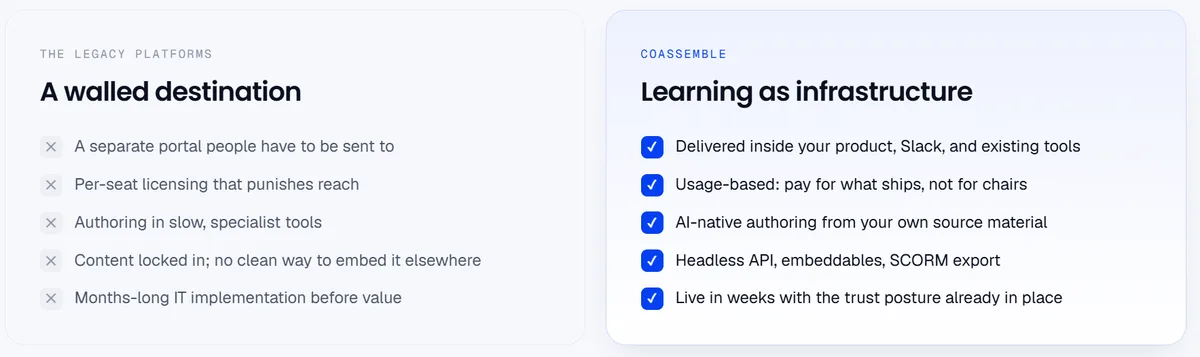
Adding embedded e-learning capabilities turns your platform into a complete learning experience. The result is flexibility and control, competitive differentiation, stronger retention, faster time-to-market, and new revenue opportunities.
Flexibility and control
Product owners want full control over the user experience and the data behind it. Inflexible, out-of-the-box platforms don't allow that:
- You can't shape the interface around your own product.
- You can't wire learning into the tools you already run.
- You're stuck with someone else's idea of what a course should look like.
Embedded e-learning flips this. The API and embeddable components become building blocks you control, not a system you have to adopt wholesale.
Competitive differentiation
Dashboards, tracking, and analytics have become standard across LMS platforms. What's rare is content creation built directly into the platform itself.
When users can build courses inside your own interface, you offer something no SCORM upload can match: speed, branding, and flexibility. According to eLearning Infographics, 72% of businesses see their LMS as a competitive advantage, yet most still lean on external tools for authoring.
Platforms with embedded e-learning win by design. They combine reliability with creativity to help teams adapt faster and keep learners engaged.
User experience and retention
Every extra login or external tool pushes users further from your platform. Embedded e-learning keeps everything in one place.
Users design, edit, and share content without breaking flow or switching tools. The experience feels cohesive and fully branded:
- Courses, video content, and interactive elements live in one connected space
- Learner engagement rises when nothing forces them to leave the platform
- A unified experience encourages social learning and collaborative learning, where teams share insight naturally
That consistency compounds. One study found active, interactive learning boosts knowledge retention by up to 54% compared to traditional, passive formats. For platform owners, this means higher retention. When users build and deliver inside your product, they stay invested.
Time-to-market and cost savings
Building authoring tools from scratch takes years and a serious development budget. Even strong engineering teams find an intuitive course builder a major investment.
With embedded e-learning, your team focuses on what makes your platform unique, while the authoring and delivery layer runs on infrastructure already built for it. According to a study by Brandon-Hall Group, online courses take 40-60% less time than classroom training, a gap that compounds with every new course. That means:
- Faster releases, without a multi-year build
- Fewer maintenance demands on your own engineering team
- Predictable costs instead of an open-ended development project
The result is speed without compromise: platforms that evolve quickly and meet user expectations faster than competitors still building in-house.
Revenue opportunities
Embedding authoring tools directly into your platform unlocks premium features your customers will pay for. Tiered plans, per-creator pricing, and AI-powered upgrades all become clear value drivers.
Forrester Consulting research found that companies with formalized customer education programs see a 7.6% average increase in top-line revenue, alongside gains in retention and product adoption.
Some platforms take it further:
- Branded course marketplaces that customers pay to access
- Licensing models built around content teams create inside your product
- Analytics-based upsells that turn tracking data into a paid tier
Embedded e-learning turns engagement into growth. Every course built inside your product adds value to both sides of the business.
Key features to look for in an embedded learning solution
Choosing an embedded e-learning partner means finding the right foundation to build on. The best solutions balance security, flexibility, integration support, and enterprise readiness.
Security
Enterprise buyers need confidence before anything gets signed off. A strong embedded solution should offer:
- SOC 2 Type II certification, independently audited
- Clear data residency options across regions
- A documented AI policy that protects your content and learner data
- An immutable audit trail for every version, approval, and completion
Without this, a promising pilot rarely survives procurement review. Security isn't a feature to check later — it's what makes the rest of the integration possible.
Coassemble publishes its full security and compliance posture in a dedicated trust center, so your team can review it before you ever get on a call.
Flexibility and customization
An embedded e-learning solution should feel like it was built in-house, not bolted on, so instructional designers and product teams can work in the same environment.
Deeper customization scales with your plan:
- Build gives you the full platform and full API, ready to drop into your product as-is
- Scale and above add the Themes API, so you can apply custom colors, fonts, and logos programmatically, per tenant, without a rebuild
Either way, users create and complete courses without leaving your platform, using components built to sit inside your existing interface rather than replace it.
See what's included at each plan level →
Documentation and integration
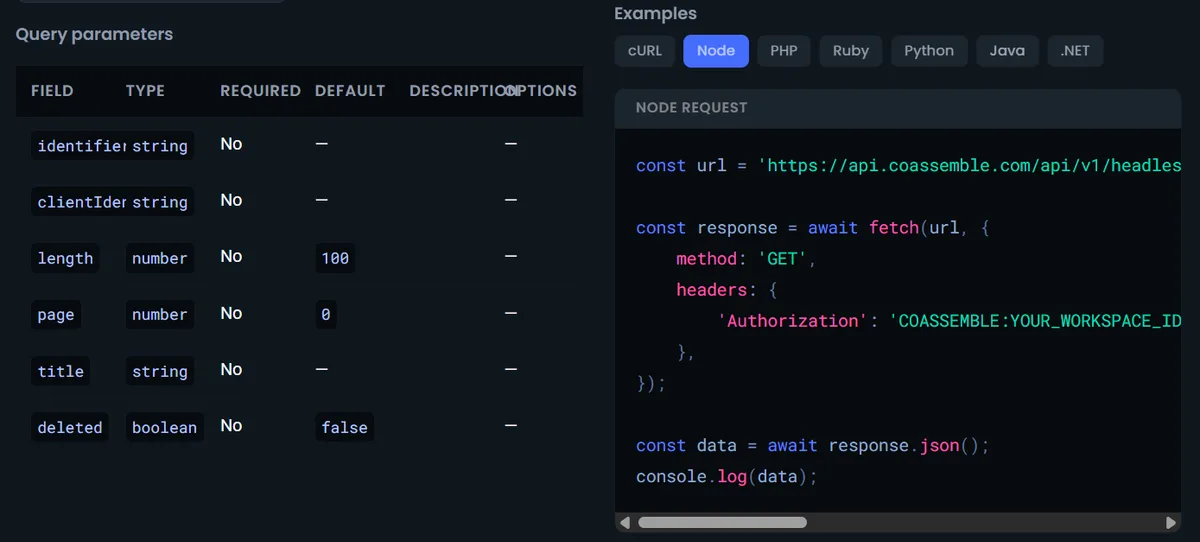
An embedded e-learning solution is only as good as the integration experience behind it. Product teams need to move from scope to production without months of back-and-forth.
Look for:
- A signed embed URL flow: authenticate, request a signed URL, render it in an iframe
- Clear entitlements, so you know upfront which features require which plan
- Real code examples across multiple languages, not just a reference spec
- A documented path from a learner-facing embed to authoring, analytics, and other components
Coassemble's developer docs walk through this exact flow: set your authorization header, fetch a course ID, request the signed embed URL, then render it. From there, teams can move on to embedding authoring tools, analytics, and other components as needed.
Enterprise readiness
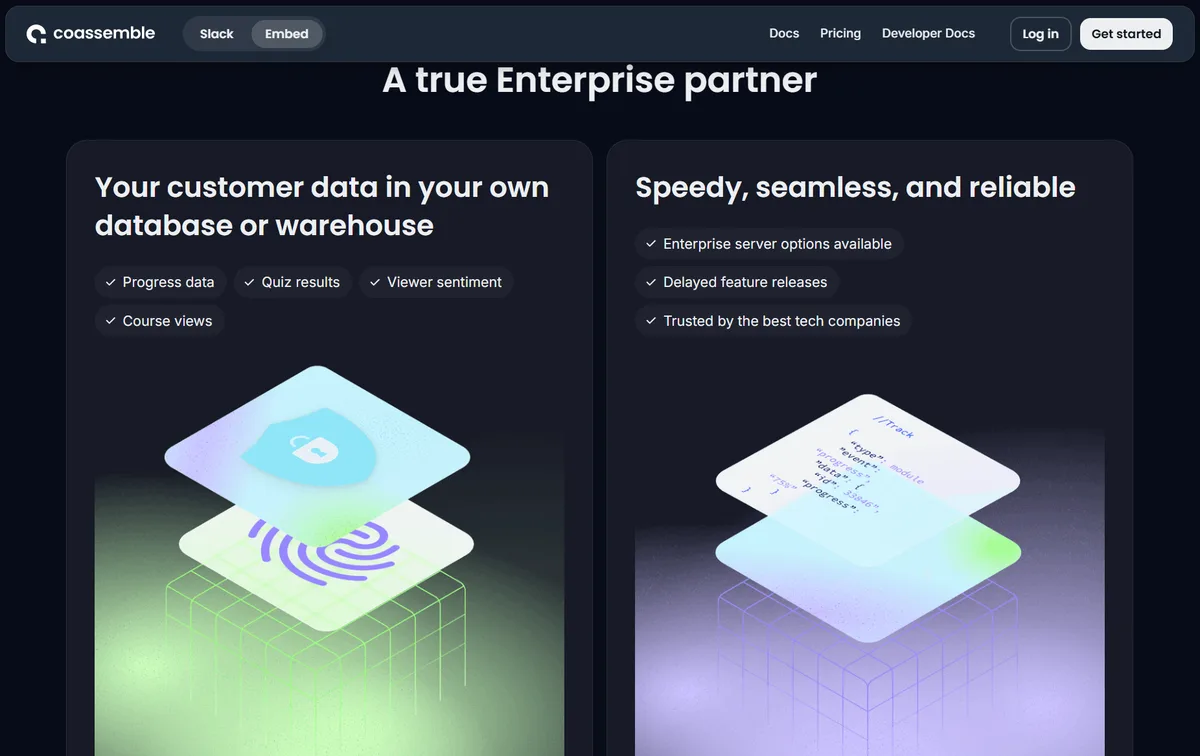
Enterprise partners need proof that a learning integration can scale securely, not just a demo that works once. Look for a solution built around:
- Data ownership options, so customer progress data can live in your own database or warehouse
- Region-locked or self-hosted infrastructure for teams with strict data residency requirements
- A documented AI policy covering how the platform handles your content and learner data
- Dedicated implementation support once an integration moves from MVP to production scale
Coassemble's Partner tier adds dedicated servers, full data residency, and a negotiated MSA for teams that need legal sign-off before launch. That's the difference between a pilot that stalls in procurement and one that clears review the first time.
Wrapping up
Embedded e-learning turns your platform from a delivery system into a complete learning experience. Course creation happens where your users already work, not in a separate tool they have to leave your product to reach. It opens up new ways to build and ship learning content, without adding another system to manage.
The shift pays off across the board. Teams ship faster, cut development costs, and unlock new revenue streams, all while keeping learners inside a single, branded experience. Security, flexibility, and solid documentation make the difference between a pilot that stalls and one that scales.
Your platform already holds the knowledge your users need. Coassemble Embed just gives you a way to put it to work, right where they already are. Learning doesn't stand still, and neither should your platform.
Request a sandbox → Free, no card required, and set up around what you're actually building.
FAQs: embedding e-learning in an LMS
How do I integrate a course creation platform into an LMS?
Use an API-first embed solution like Coassemble Embed. Authenticate with a workspace key, request a signed embed URL, then render it in an iframe inside your platform.
What learning API can I use to embed courses in my product?
Coassemble's API lets you generate, embed, and track courses directly in your product, with endpoints for courses, collections, tracking, and analytics.
What is the best platform for embedding in-app learning experiences for users?
The best fit depends on your stack and security needs. For most product teams, an API-first solution with embeddable components — like Coassemble Embed — balances speed, control, and enterprise readiness.
Keep reading
What is the best embeddable training software for SaaS platforms?
Embeddable training software puts course creation, delivery, and tracking inside your product instead of a separate portal. Here's what to look for, and how the top SaaS options compare in 2026.
What is a learning infrastructure, and how is it changing?
Learning infrastructure is the systems that create, deliver, and track training. Here's what it includes, how it differs from an LMS or a learning ecosystem, and how embedded learning and AI agents are changing the model.
What training software has the best API and developer documentation?
A robust API means little if the docs are unclear or support-gated. Six practical checks for evaluating a training platform's API and developer documentation before a sales call.