The Best LMS Alternatives for Product Teams Building In-House
You've got a mandate: get training inside the product, not off in a separate portal. A standalone LMS solves training, but it doesn't solve embedding. This guide breaks down what actually counts as an LMS alternative, what to evaluate before you commit, and where an embeddable, API-first platform like Coassemble Embed fits if you're building training into your own product.

You've got a mandate: get training inside the product, not off to the side in a separate portal. A standalone LMS solves training, but it doesn't solve embedding.
This guide breaks down what actually counts as an LMS alternative, what to evaluate before you commit, and where the embeddable option fits if you're building training into your own product.
The limitations of traditional LMS
Traditional LMS platforms were built for an era of centralized, compliance-first training, when a separate portal was the only way to track completions. From a builder's perspective, the cracks show fast:
- Content is locked in. Courses live inside the platform with no clean way to pull them into your own product. If you want training somewhere else, you're stuck exporting or rebuilding.
- No real API access. Most platforms weren't designed to be built on. You can configure them, but you can't embed their core functionality into your own interface.
- Per-seat pricing punishes reach. Costs climb with every learner you add, even though reach is the entire point of training people at scale. Gartner projects at least 40% of enterprise SaaS spend will shift to usage- or outcome-based models by 2030, up from just 15% in 2022.
- Months of IT implementation before value. Getting from purchase to production often means procurement, integration work, and a rollout measured in quarters, not weeks.
- One-size-fits-all design. Most platforms assume every team learns the same way. The experience rarely matches what your users or your product actually need.
The result is a walled destination. Learners have to leave what they're doing to go get trained, then leave training to get back to work.
What is an LMS alternative?
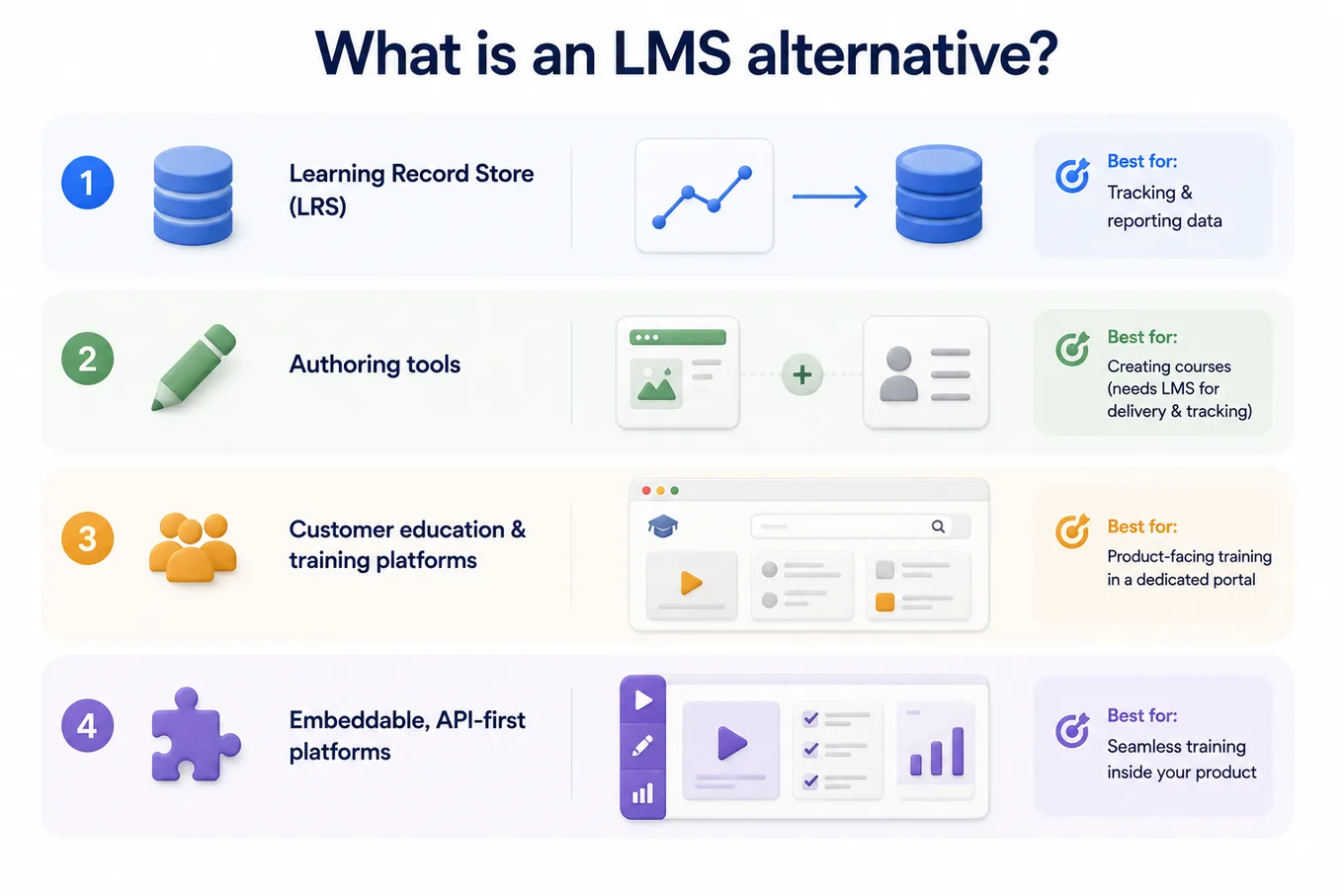
An LMS alternative is any tool or approach that delivers, tracks, or manages training without a traditional standalone learning management system. Not every alternative solves the same problem, though. Before you evaluate options, it helps to know which category you're actually looking at.
Learning Record Store (LRS)
An LRS tracks and stores learning activity data, often using the xAPI standard. It's a record-keeping layer, not a delivery or authoring tool. It doesn't build courses, host content, or deliver training. If you already have both, it can serve as your system of record for completions and progress.
Authoring tools
Authoring tools let you build courses — lessons, quizzes, interactive screens. They're built for content creation, not delivery or tracking. Once the content exists, you still need somewhere to deliver and track it, which usually means pairing the tool with a separate LMS. If you're evaluating authoring tools specifically, see AI eLearning authoring tools for faster course creation.
Customer education and training platforms
These platforms are closer to embeddable territory. They're often built with product-facing training in mind, not just internal L&D. Even so, most are still portal-based. Learners typically go to a dedicated hub rather than staying inside the product they're already using.
Embeddable, API-first platforms
This category is different. The course player, builder, and analytics exist as components you drop directly into your own product. There's no separate destination — instead of sending people out to a standalone LMS, you embed the learning where they already work. Training becomes part of the interface your users already know.
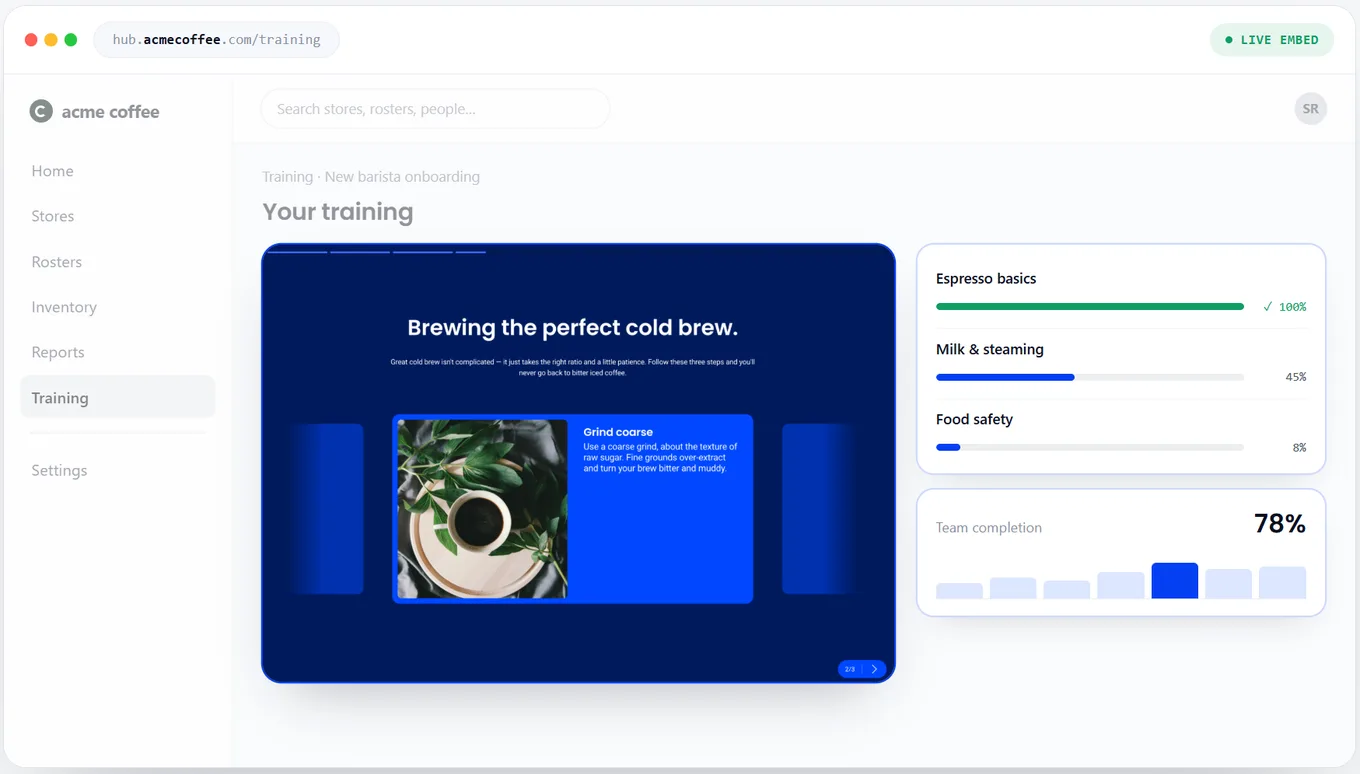
Only this last category lets you skip a standalone LMS entirely. The others solve pieces of the problem. This one removes the walled destination altogether.
If you're weighing this against adding authoring into an LMS you already run, read The LMS is no longer enough: the shift toward embedded learning. For the broader question of skipping an LMS altogether, see Hosting eLearning outside of an LMS: your real options.
What to look for in an LMS alternative
Once you know which category fits your problem, the next step is evaluating options within it. Here's what actually matters, criteria by criteria.
API and embed access
Can you drop the player, builder, or analytics directly into your own product? Or are you stuck sending people to a separate portal? This is the single biggest factor if embedding is the goal.
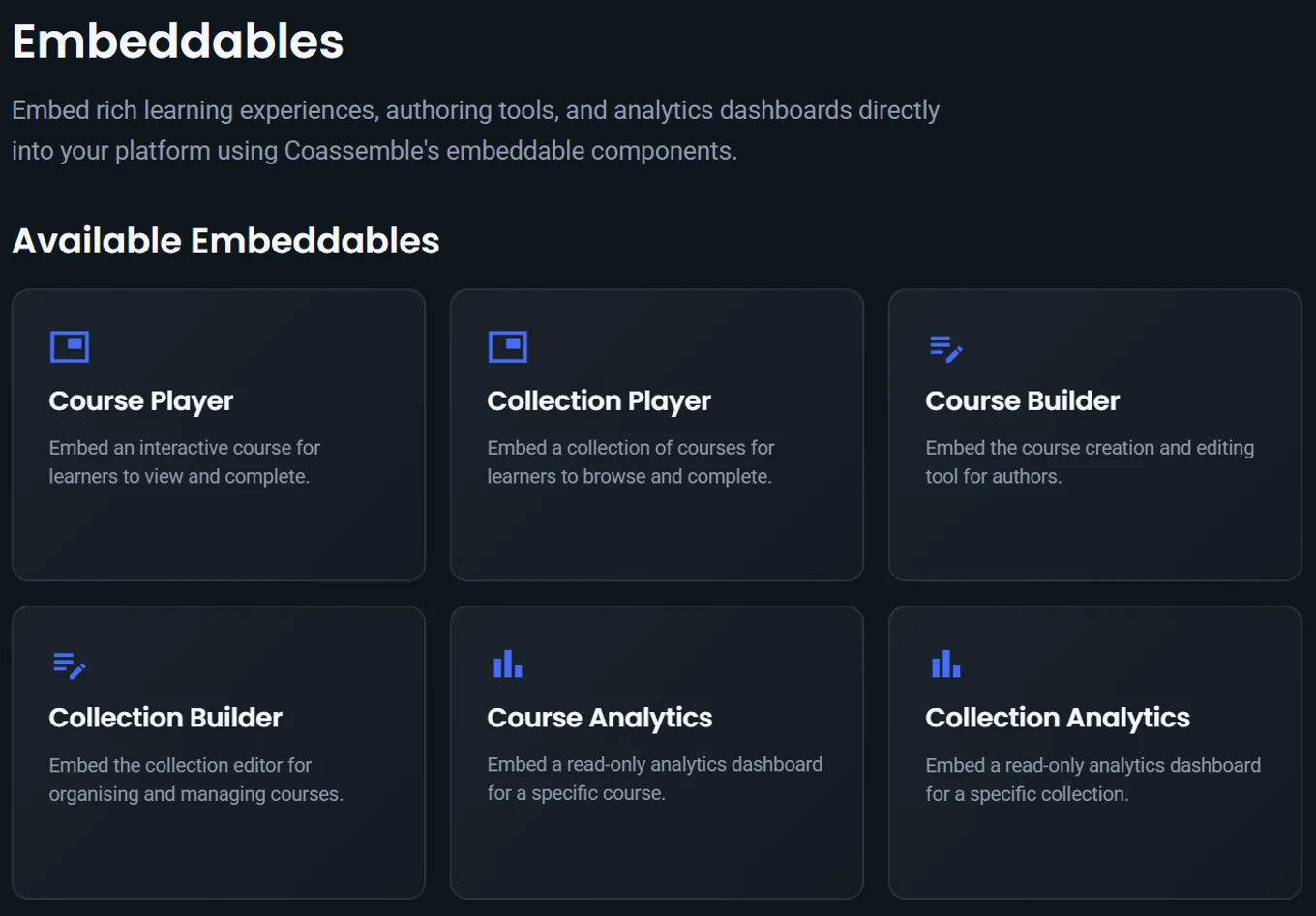
Coassemble Embed offers a full set of embeddable components, including a course player, a course builder, and analytics dashboards for courses, collections, and users.
Pricing model
Usage-based pricing works differently. Instead of charging per seat, it charges based on actual usage — like the number of people who complete or engage with training.
Coassemble Embed prices this way, measuring usage by Identified Recipients (IRs) rather than seats, so cost tracks real training volume instead of headcount. See current pricing.
Who it's built for
Some alternatives, like an LRS or an authoring tool, solve one piece of the puzzle well — they're not trying to be everything. Others are full walled portals, built for L&D teams rather than product teams. Know which one you're evaluating before you commit budget or engineering time.
Time to production
Traditional LMS and enterprise platforms often mean months of IT implementation before anything ships. Corporate LMS rollouts typically take 6 to 16 weeks, depending on organization size and complexity. API-first platforms skip most of that. There's no portal to configure or rollout to plan — just an API you call.
Ownership of the learner experience
Can you brand, theme, and localize the experience as your own? Or does it look and feel like a bolted-on third-party tool? Learners notice the difference, especially inside a product they already trust. A mismatched experience undercuts the credibility of the training itself.
Where it fits in your stack
Does the platform require migrating away from tools you already use? Or does it slot into what you've already built? The best alternatives add capability without forcing a rebuild. That matters most for teams who can't afford to pause and re-platform.
Why Coassemble Embed
Coassemble Embed is built for the category defined above: API-first, not portal-first. You can test all of it in a free sandbox before committing to anything.
Every criterion above points to the same kind of platform, and Coassemble Embed is built to answer each one directly:
- API-first by design. The course player, course builder, collection builder, and analytics dashboards exist as embeddable components. None of it requires a separate portal.
- Usage-based pricing. You pay for what ships, not for seats. Growth doesn't punish you the way per-seat pricing does.
- Built for product owners and developers. The API and documentation are written for technical teams, not just L&D admins.
- Live in weeks. Full API access and embeddable components drop into your interface as native building blocks, not a months-long rollout.
- AI-native authoring. Generate courses from your own source material. It's a supporting feature, not the headline.
- Enterprise-ready. SOC 2 Type II, data residency options, and dedicated environments are already in place.
If you're evaluating whether to build against a real API, the fastest way to know is to try it. Explore the developer docs, or request a sandbox to build against your actual stack. No card or commitment.
Choosing the right LMS alternative for your product
Choosing an LMS alternative starts with knowing what you actually need. An LRS handles tracking. Authoring tools handle content creation. Customer education platforms sit closer to product-facing training. Only an embeddable, API-first platform lets you skip a standalone LMS entirely.
If your team owns a product, that last category is worth evaluating closely. It's the one built for training inside your own product. Look for real API and embed access, usage-based pricing, and a fast path from evaluation to production.
Coassemble Embed was built around those requirements. It offers embeddable components, usage-based pricing, and a live sandbox, rather than a slow procurement cycle.
The right choice depends on what you're actually trying to solve. But for teams building training into their own product, an embeddable platform is often the simplest path forward.
FAQs: best alternative to LMS
What's the difference between an LMS and an embeddable learning platform?
An LMS is a separate portal learners log into. An embeddable platform drops the player, builder, and analytics directly into your own product, so there's no destination to leave.
Can I replace my LMS with an API instead?
Often, yes — if your training need is embedding learning into a product you own. An API-first platform gives you the same core pieces as components, not a separate system.
Is Coassemble a good LMS alternative?
Yes, especially for training customers, partners, or your own product's users. Coassemble Embed swaps the portal model for an API you drop into what you're already shipping. A traditional LMS may still fit better for closed, internal-only compliance training.
Do I still need an LMS if I embed learning into my product?
Not necessarily, if the embedded experience covers your training needs end-to-end. For internal compliance tracking layered on top of that, some teams still keep both.