Which Learning Platforms Support AI Agents or MCP?
Nearly half of software companies now use MCP in production. Most learning platforms haven't caught up — ask one to enroll a new hire and it can't respond, because it's built for a person clicking a login screen, not a tool an agent can call. Here's what MCP actually means for training infrastructure, and how to tell which platforms are ready.
Nearly half of software companies now use Model Context Protocol (MCP) in production, according to Stacklok's 2026 industry survey. Most learning platforms haven't caught up. Ask one to enroll a new hire, and it can't respond. It's built for a person clicking through a login screen, not a tool an agent can call.
MCP is the emerging standard for letting agents call tools directly. It replaces one-off custom integrations with a shared, predictable interface. For training platforms, that raises a pointed question: is the underlying API solid enough to support this? Not every vendor can answer yes.
This article covers what MCP means for training infrastructure. It also covers how to evaluate a vendor's claims and which platforms are actually ready today.
Do learning platforms support AI agents through MCP?
Most learning platforms don't support AI agents through MCP yet, since MCP itself is still an emerging standard. Coassemble does. Native MCP support is live, letting Claude, Cursor, or a custom agent call the platform directly.
What is MCP and why does it matter for training platforms?
MCP standardizes how AI agents discover and call tools. Instead of custom code for every integration, an agent reads a tool list and calls what it needs.
Anthropic introduced MCP on November 25, 2024, as a common connector between AI models and outside systems. Adoption has moved fast since then.
This matters for training platforms because tracking data has real stakes. Completions, scores, and audit trails need the same governance whether a person or an agent touches them.
Why the API/MCP distinction matters for training and tracking data
Training data is a record of who did what, when. If an agent generates a course or marks it complete, that action needs an audit trail.
It needs the same one a person's action would get, tracked through the same tracking API that already logs completions, scores, and progress for human learners. Otherwise, reporting breaks and compliance gets murky fast.
What should you look for in an MCP-ready learning platform?
MCP readiness starts before MCP itself. It comes down to how the underlying platform is built. Look for a mature LMS API, governance that extends to agents, an automation API with webhooks for write-back, and honest vendor transparency.
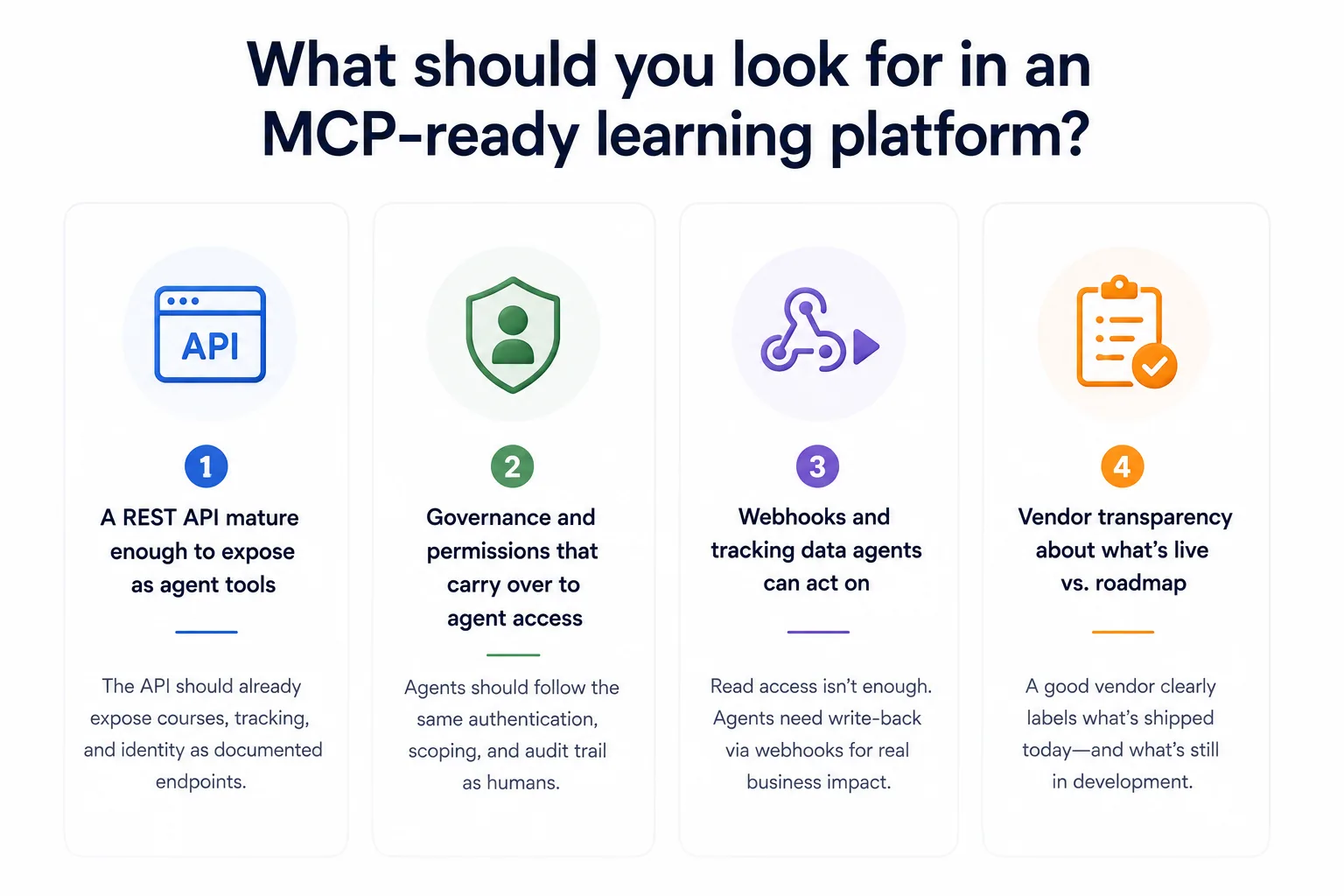
A REST API mature enough to expose as agent tools
An MCP server is only as good as the API underneath it. Coassemble's REST API already exposes courses, tracking, and identity as documented endpoints. That surface area is exactly what an MCP server wraps as tools. A platform without that groundwork has nothing to build on.
Governance and permissions that carry over to agent access
An agent calling the API should follow the same rules a person would. That means the same authentication, scoping, and audit trail. A separate, looser access model for agents is a red flag, not a feature.
Webhooks and tracking data agents can act on
Read access alone isn't enough for an agent to be useful. It needs write-back too: completions, progress, and events flowing into your HRIS or CRM. Webhooks are what make that possible — an automation API that pushes events out, rather than forcing you to poll the API constantly.
Vendor transparency about what's live vs. roadmap
Does the vendor clearly separate what's shipped from what's "coming soon"? This space is full of marketing pages that blur the two. A transparent vendor labels what's live today, and labels what's still in development just as clearly. Coassemble's MCP support has moved from roadmap to live.
How does Coassemble approach AI agents and MCP?
Coassemble is one example of this pattern: API-first, with native MCP support now live. Rather than launching MCP first and backfilling the API, Coassemble built the API first. MCP came after, layered on top of it. Whether that order is common elsewhere is worth checking with the same questions above.
What Coassemble's API already supports today
The REST API already covers courses, tracking, and identity management — the primitives that power its MCP layer:
- Courses: generate, publish, duplicate, and delete courses programmatically
- Tracking: completions, scores, and progress at the course, screen, and user level
- Identities: manage clients and users, so agent access can be scoped the same way human access already is
Together, this is the surface area the MCP layer wraps as callable tools. It isn't something built from scratch for MCP alone.
How Coassemble's MCP support works
Coassemble's MCP support lets Claude, Cursor, or a custom agent connect directly to the platform. From there, an agent can:
- Generate a course from source material
- Publish it and share it into a workflow
- Read back completions as they happen
How do you evaluate vendor MCP claims without getting misled?
Coassemble's API and MCP status are one data point. The checklist below is how to check any vendor's claims, including Coassemble's own.
- Ask for developer docs, not just a landing page. A vendor with a real API can point you straight to them.
- Check whether a claimed integration is official or a third-party wrapper. Coassemble now has an official one.
- Test the sandbox yourself rather than trusting the marketing copy. If you can call the API in ten minutes, that tells you more than any page.
Evaluate the API, not the MCP badge
The real evaluation question isn't whether a platform has MCP support. It's whether the underlying LMS API is strong enough that MCP, native or third-party, makes sense on top of it. That's a question you can check yourself, rather than take a vendor's word for it.
Coassemble's developer docs are open to read, and you can request a free sandbox to test the API directly — no card required.
FAQs: Learning platforms that support AI agents or MCP
Do learning management systems support AI agents via MCP?
Most don't yet. MCP is still emerging, and few learning platforms have native support live today.
Which LMS platforms support AI agent API orchestration for training programs?
Few platforms publish this clearly. Look for a mature REST API covering courses, tracking, and identity, since that's what any AI agent API orchestration for training programs actually needs.
Does Coassemble support MCP for AI agents?
Yes. Native MCP support is live, and the REST API underneath it has been documented and stable for longer.
How does LMS and AI agent orchestration work for training?
An agent should call the platform's LMS API or MCP tools under the same governance a human user would, though not every platform enforces this today.
Keep reading
How do I build a customer training academy inside my application?
Most guides tell you to stand up a separate LMS. Here's the other way: build the customer training academy inside the product your customers already use, through an API.
How do I embed interactive courses inside a web application?
iframe, JavaScript component, API-driven signed URLs, or SCORM? Here's how each approach to embedding a course inside your own web app trades off control, security, and effort.
Best practices for building an in-app customer training academy
What separates an in-app academy that gets used from one that gets ignored? Start from content you already have, keep lessons short, match your brand, segment, and trigger training in context.