What Is a Learning Experience Platform (LXP)?
Most articles on learning experience platforms are written for people who already run a mature training program. This one is for someone who's just been handed a knowledge problem to solve, fast. Here's what a learning experience platform is, how it fits next to an LMS, its key features, and the examples worth knowing — so you can tell whether an LXP is the right fit for your team.
Most articles on learning experience platforms are written for readers who already run a mature training program.
This one takes a different angle. It's built for someone who's just been handed a knowledge problem to solve, fast. Here's what a learning experience platform is, how it connects to the other training tools you might already have, and how to tell whether it's the right fit for your team.
What is a learning experience platform?
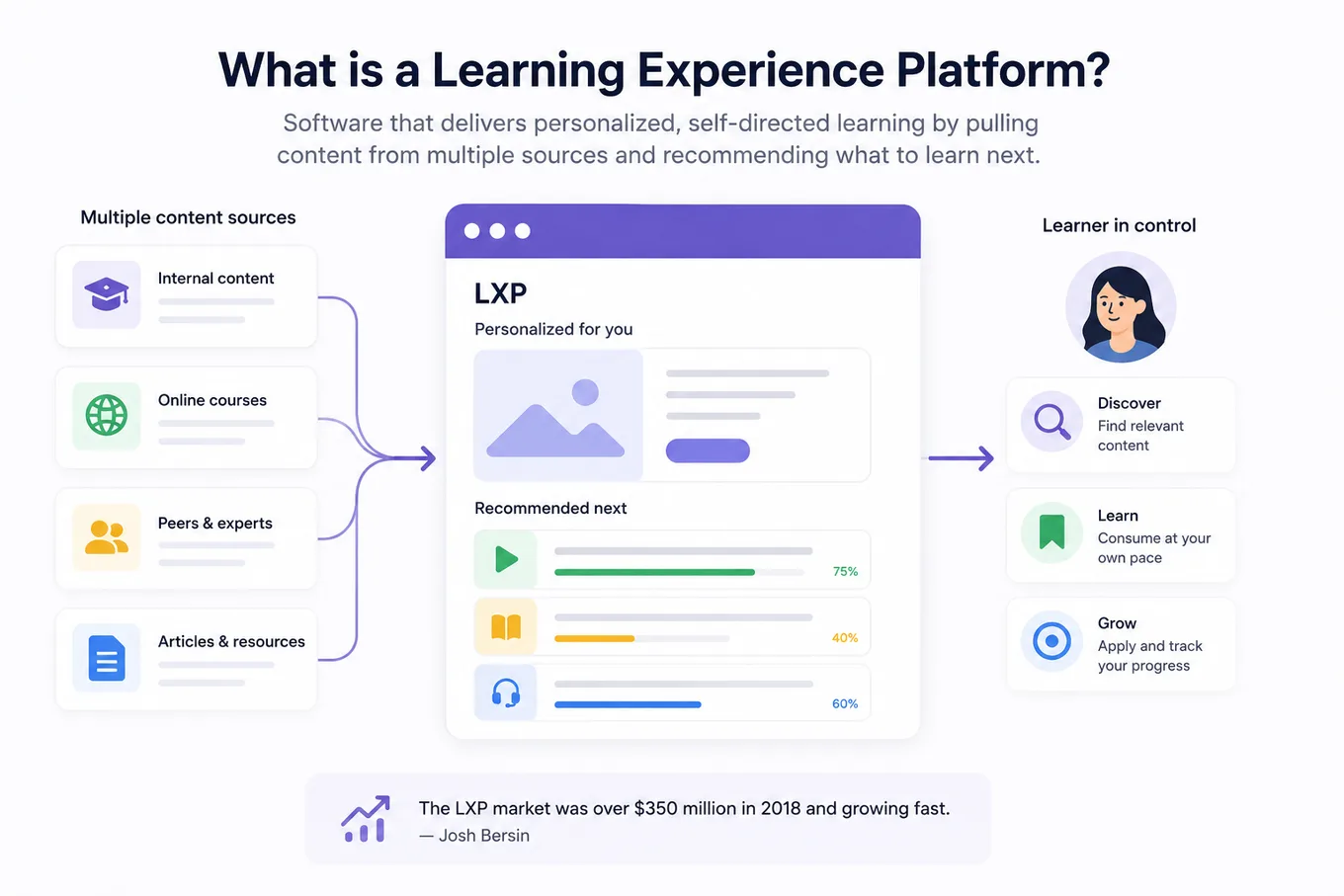
A learning experience platform, or LXP, is software that delivers personalized, self-directed learning by pulling content from multiple sources and recommending what to learn next. It puts the learner in control, rather than assigning fixed coursework from the top down. The category sits next to the learning management system, not in place of it.
Industry analyst Josh Bersin coined the term around 2017–2018 to describe a pattern he saw forming in the market. He pointed to platforms like Degreed, EdCast, and Pathgather as early examples, all built around personalized, learner-led content rather than administered courses. By 2018, Bersin estimated the LXP market at over $350 million, growing rapidly as companies sought to make learning feel less like compliance and more like discovery.
In practice, a learner logging into an LXP might see a recommended video on a new industry trend, a peer-created guide from a colleague, and a curated learning path tied to their current role. Topics range from technical skills to leadership and professional development, drawn from internal content and providers like Coursera or LinkedIn Learning. The platform surfaces all of it automatically, based on who they are and what they've engaged with before.
Is an LXP actually right for your team?
LXPs are powerful for large organizations with mature L&D functions and budgets to match. For most fast-moving teams with a specific knowledge mandate — onboarding, product updates, industry trends, or process rollouts — an LXP is often more infrastructure than the problem requires. It depends on your scale and how much training infrastructure you already have.
When does an LXP make sense?
An LXP makes sense for large enterprises with a dedicated L&D team and a long-term focus on skills development and career pathing. You need the resources to curate, maintain, and govern a platform at scale, because LXPs depend on a steady stream of content and active management to stay useful.
Without that, the recommendation engine has little to recommend. Here's what makes up that recommendation engine, so you can weigh it against your own setup.
Key features of a learning experience platform
LXPs share a common set of capabilities built around personalization and choice. They use AI to recommend content, pull from multiple sources, support peer-to-peer learning, and track skill growth rather than just completions. Together, these features shift learning from something assigned to something discovered.
AI-driven content recommendations
LXPs use machine learning to surface relevant content based on a user's role, past activity, and skill gaps, rather than a fixed, top-down curriculum. For a closer look at how AI-driven training compares with traditional systems, see AI-powered training vs. a traditional LMS.
Multi-format, multi-source content
Unlike an LMS that mainly hosts internal courses, an LXP pulls from internal and external sources — videos, articles, podcasts, and platforms like LinkedIn Learning or Coursera. The goal is one place to find all your learning resources, wherever they originally live.
Social and collaborative learning
LXPs support user-generated content, comments, ratings, and user profiles. Learning becomes something people do together — a shared activity, not a solo checkbox exercise.
Analytics and skills tracking
LXPs track engagement and skill development over time, not just who finished what. That's a meaningful shift from traditional LMS reporting, which stops at completion rates and rarely shows real skill development.
LXP vs LMS: what's the actual difference?
The core difference is control. An LMS puts administrators in charge: they assign content, track completions, and manage compliance. An LXP puts the learner in charge, letting them explore and learn at their own pace while AI recommendations guide the way.
Neither approach is wrong. They're built for different jobs, and many companies end up using both side by side.
| LMS | LXP | |
|---|---|---|
| Driven by | Admins | Learners |
| Content | Internal, assigned | Internal + external, curated |
| Learning type | Formal, compliance | Self-directed, continuous |
| Best for | Mandatory training | Skill development |
| Delivery | Platform-based | Multi-channel |
If you're trying to figure out where your own setup fits, examples of knowledge management systems can help map out what's already in place before you decide what to add.
Examples of learning experience platforms
Teams building a custom learning experience, or evaluating an off-the-shelf LXP, have a few strong options. They include Coassemble, Degreed, 360Learning, and Docebo — each suited to a different kind of team and use case.
1. Coassemble — best for technical teams building their own custom learning experience
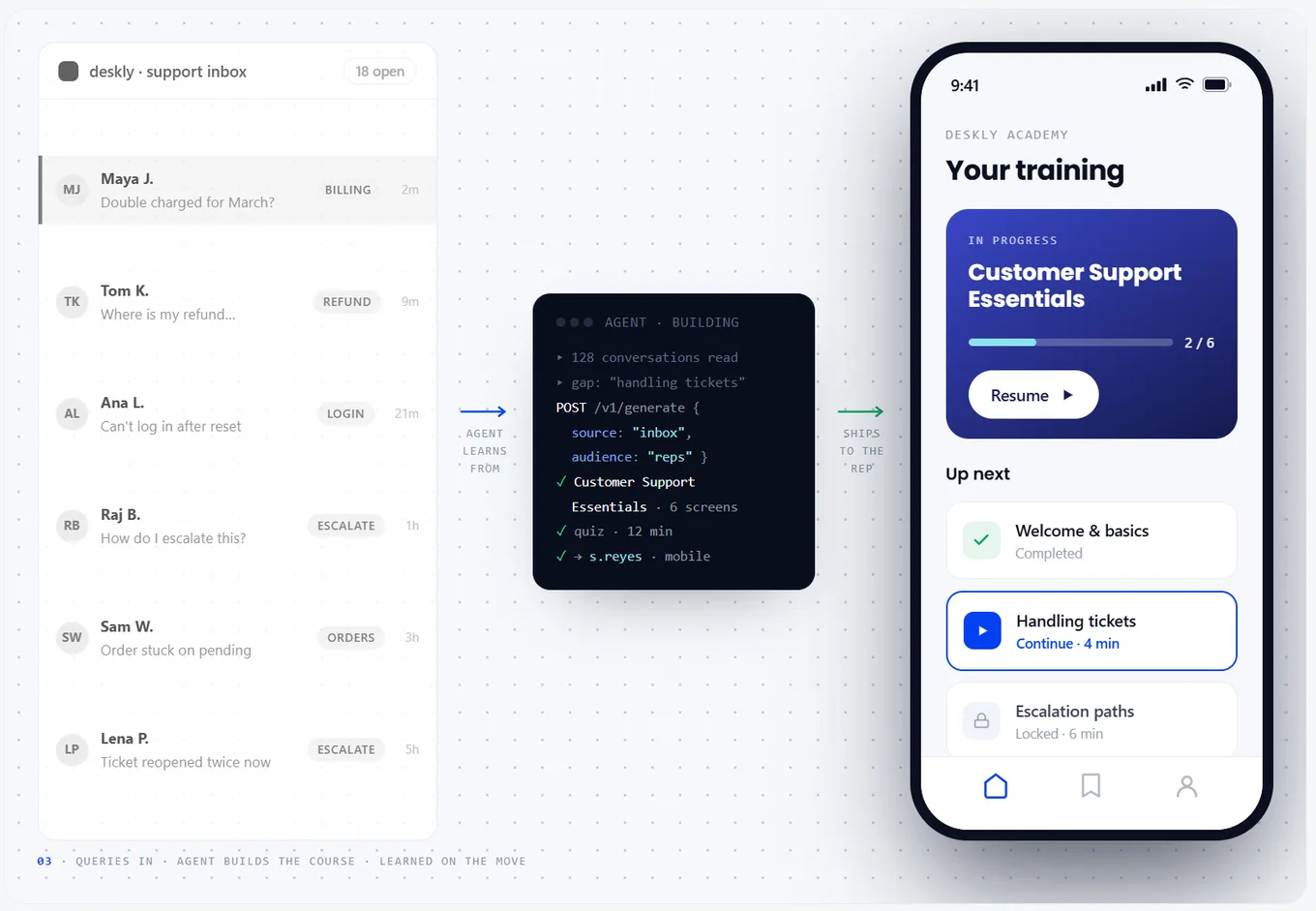
Coassemble is an API-first course-creation tool you use to build your own custom learning experience, rather than adopting an off-the-shelf LXP.
Teams embed Coassemble directly into their existing product or portal using the REST API and webhooks, so learning lives inside an environment they already own rather than a separate platform learners have to visit. Course content plays through an embeddable player themed to match your own brand, with progress and completions written straight back to your own database.
It's built for technical teams who want control over the experience, the data, and the integration, without standing up an LXP from scratch. The player can be fully white-labeled, and content can be exported to an external LMS via SCORM when you need it.
2. Degreed — best for large enterprises mapping learning to workforce skills
Degreed is built around skills intelligence, not just content delivery. It uses AI to guide personalized learning programs that address skill gaps and connect development to business outcomes. The platform aggregates learning from internal resources, external providers, and the open web into a single searchable experience. It's designed for large enterprises that want to move beyond tracking completions and start mapping learning directly to workforce capability.
3. 360Learning — best for enterprises scaling internal expertise into training
360Learning positions itself as the platform for turning internal expertise into scalable training. It merges LMS and LXP capabilities, including agentic AI automation, adaptive coaching, and a multimodal AI content builder. Its collaborative authoring model lets subject-matter experts build and share knowledge without needing L&D to act as a gatekeeper, and it integrates with tools including Slack, Salesforce, and major HRIS platforms.
4. Docebo — best for mid-sized to large orgs training employees, partners, and customers together
Docebo offers learner-engagement features like gamification, social learning, learner communities, and quizzes, alongside integrations and automations to streamline workflows. Its AI layer, called Harmony, handles search, support, and content recommendations, while its Creator tool lets admins generate interactive learning content quickly. It's designed for mid-sized to large organizations, supporting employees, partners, and customers from a single platform across onboarding, compliance, and customer education.
The real question isn't LXP or LMS
An LXP is learner-driven and built for continuous learning at scale. An LMS is admin-driven and built for compliance and completion tracking. Both assume a formal training infrastructure that most fast-moving teams don't have — and don't need.
The real question isn't whether you need an LXP or an LMS. It's where knowledge actually needs to live for your team to use it. When it lives inside a product people already use, it gets used. When it lives somewhere else, it gets ignored.
If you want to explore building a custom learning experience directly into your own platform, see how embedded learning works, or request a sandbox → and see how it fits into what you're already building.
FAQs: learning experience platforms
What is a learning experience platform in simple terms?
An LXP is software that delivers personalized learning by pulling content from multiple sources and using AI to recommend what to learn next. Unlike an LMS, it puts the learner in control rather than assigning fixed learning paths from the top down.
What is the difference between an LMS and an LXP?
An LMS is admin-driven: it assigns courses, tracks completions, and manages compliance training. An LXP is learner-driven: it recommends personalized content based on skills and goals. Most large enterprises run both side by side.
What are examples of learning experience platforms?
Widely used learning experience platforms include Degreed, 360Learning, and Docebo. Teams can also build a custom LXP with an API-first tool like Coassemble. Each enterprise option requires dedicated L&D teams to manage content and governance.
Do I need an LXP if I already have an LMS?
Not necessarily. An LXP extends your LMS by adding self-directed, personalized learning on top of structured compliance training. If your team needs to move knowledge quickly and trackably, a lighter-weight tool may serve you better.
Is an LXP suitable for small teams?
Most LXPs are built and priced for enterprise scale. Smaller teams with a specific knowledge problem rarely need that level of infrastructure. Coassemble is built for exactly that — an API-first tool for building a custom learning experience embedded in your own product, without the overhead.
Keep reading
What is the best embeddable training software for SaaS platforms?
Embeddable training software puts course creation, delivery, and tracking inside your product instead of a separate portal. Here's what to look for, and how the top SaaS options compare in 2026.
What is a learning infrastructure, and how is it changing?
Learning infrastructure is the systems that create, deliver, and track training. Here's what it includes, how it differs from an LMS or a learning ecosystem, and how embedded learning and AI agents are changing the model.
What training software has the best API and developer documentation?
A robust API means little if the docs are unclear or support-gated. Six practical checks for evaluating a training platform's API and developer documentation before a sales call.