What is a learning infrastructure, and how is it changing?
Learning infrastructure is the systems that create, deliver, and track training. Here's what it includes, how it differs from an LMS or a learning ecosystem, and how embedded learning and AI agents are changing the model.
"Learning as infrastructure, not a destination," writes Coassemble CEO Ryan Macpherson. He means workplace learning, rather than the computing infrastructure used to train AI models.
Your customer needs help configuring a feature. Sending them to a separate training portal means leaving the task to find the lesson.
Learning infrastructure supports how you create, deliver, and track training. Increasingly, those capabilities work inside your product, bringing learning closer to the moment someone needs it.
This guide explains learning infrastructure, its components, and how embedded learning and AI agents are changing the model.
What is a learning infrastructure?
A learning infrastructure is the set of systems and components an organization uses to create, deliver, and track learning. Increasingly, these capabilities are available as building blocks that products and tools can use, rather than one platform people log into.
What are the components of a learning infrastructure?
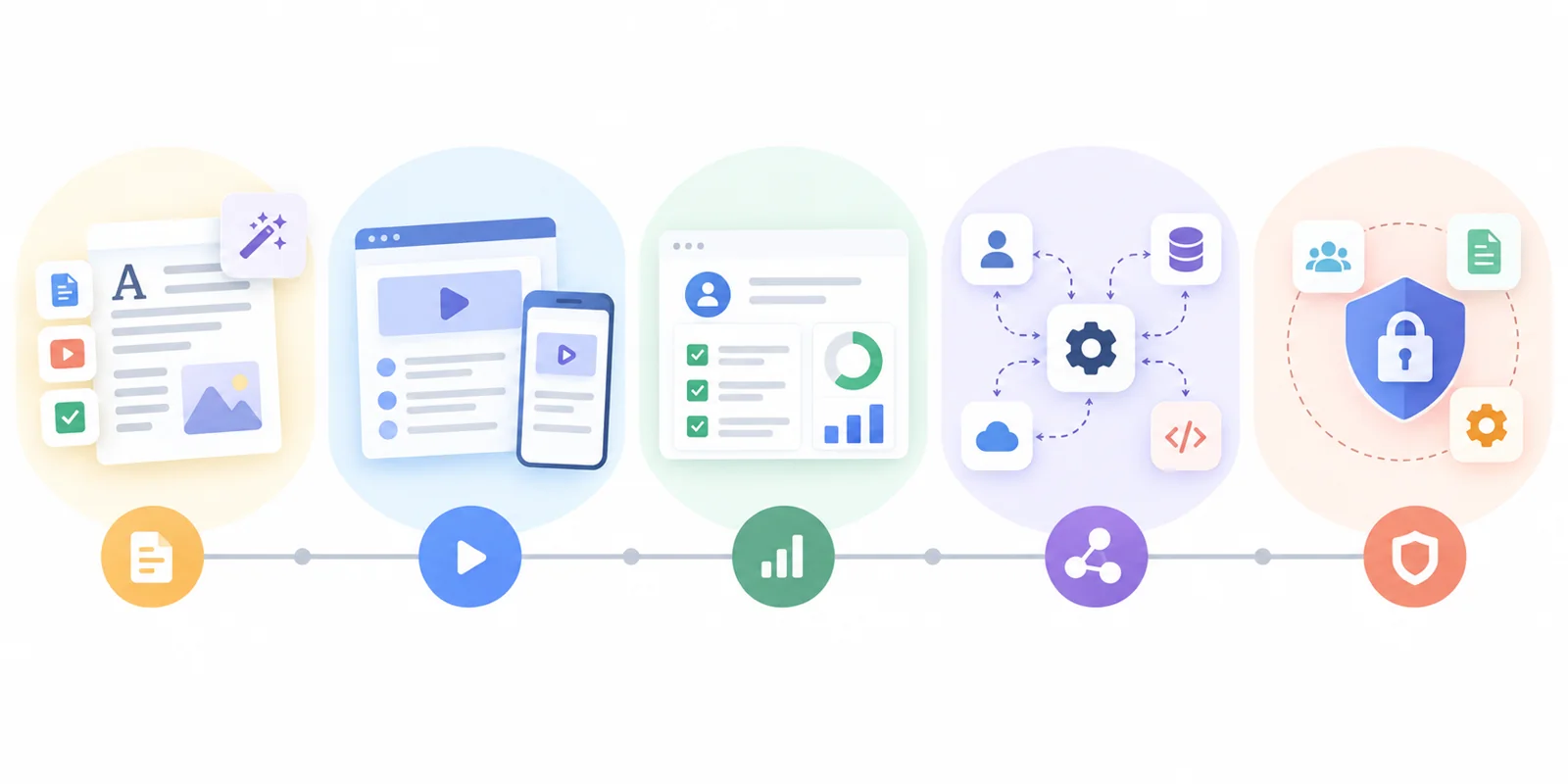
Every learning infrastructure covers five jobs: creating content, delivering it, tracking completion, connecting systems, and keeping it secure. What changes between models is where those jobs happen.
Content creation
Teams need tools to turn knowledge into lessons, courses, and assessments. Authors might build content manually or use AI to draft lessons from existing documentation.
In TalentLMS's 2026 L&D report, 22% of HR managers identified unreliable AI-generated content as a training blocker.
A SaaS product team might use AI to turn release notes into customer training. Someone still needs to review accuracy and update the content as features change.
Delivery
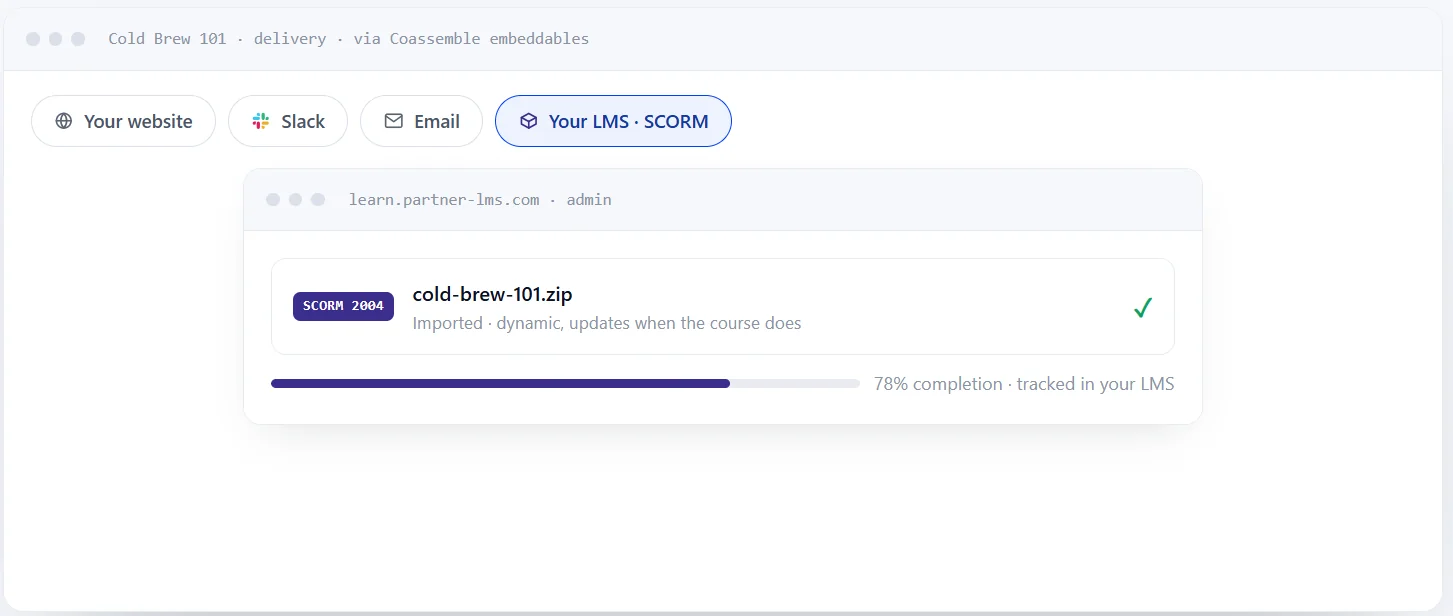
Delivery determines where learners access training and how it appears. A course might open in an LMS, an employee portal, or directly inside your product.
For example, a customer configuring account permissions could open a short lesson beside the settings. The delivery layer presents the content, while your product determines when to show it.
Tracking and records
Tracking captures progress, assessment results, and course completions, linking each record to the right learner.
A customer success team could use these records to see which administrators completed setup training before a rollout. Completion shows someone finished the course, but doesn't prove they can perform the task.
Integrations
Integrations connect learning to your existing systems and reduce manual updates. They can sync learner identities, send completion records to customer profiles, or trigger training during onboarding.
SCORM standardizes how compatible course packages communicate with an LMS. APIs support other connections, such as sending course progress to your product's reporting tools.
Security and governance
Security controls who can access content and learner records. Governance defines who approves training, maintains it, and decides how long to keep records.
In Verizon's 2025 Data Breach Investigations Report, 30% of confirmed breaches involved a third party. This broader security finding reinforces the need to review learning vendors and their access to your systems.
In a customer portal, each company's users should only see content and records they're authorized to access. Assign clear ownership for reviewing lessons when features or policies change.
How is a learning infrastructure different from an LMS or a learning ecosystem?
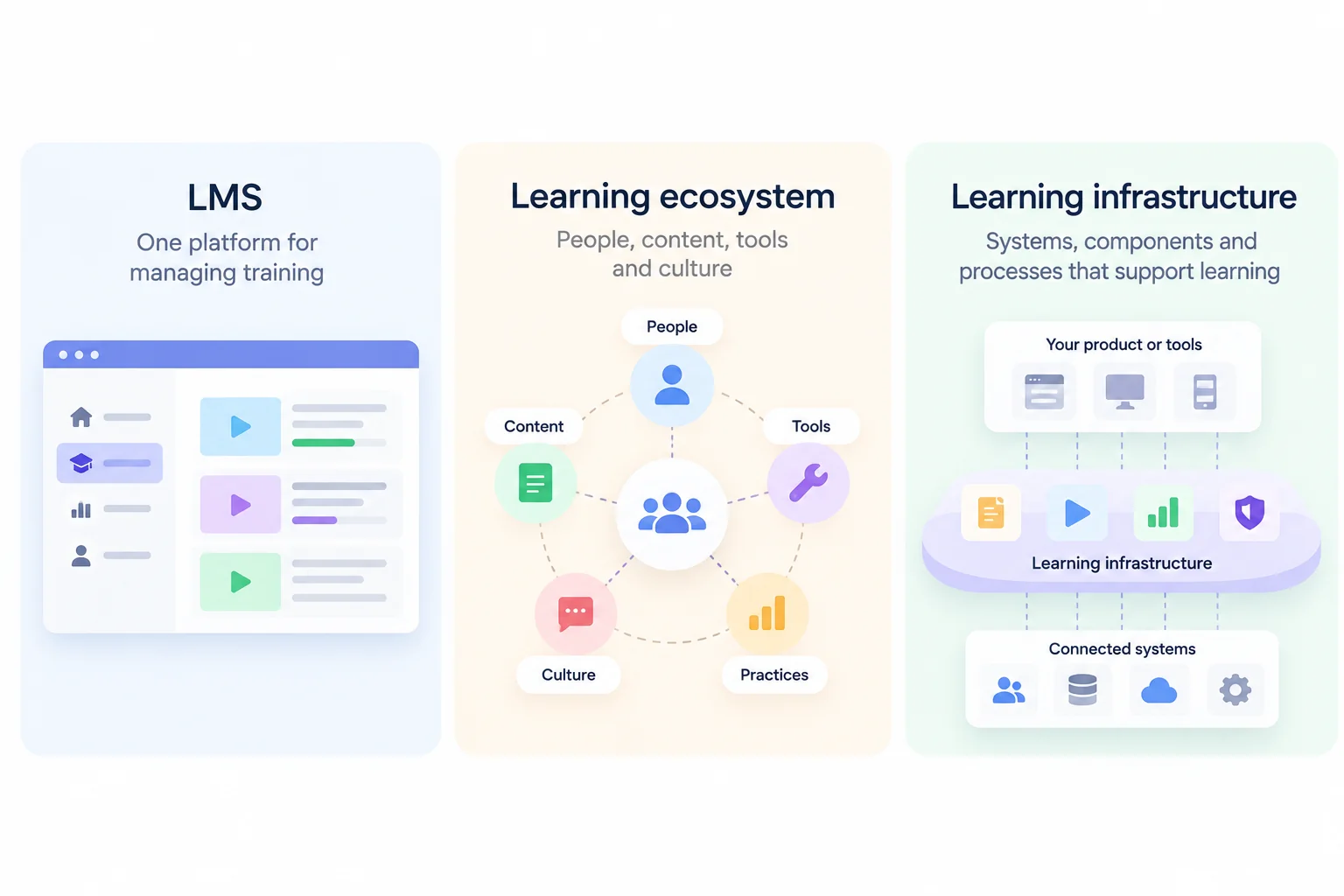
An LMS is one platform for managing training. A learning ecosystem includes the people, content, tools, and culture involved in learning. Learning infrastructure provides the systems, components, and processes that support it.
An LMS is one platform
A learning management system organizes courses, learner access, assessments, and reporting. It can provide several parts of your learning infrastructure.
Other platforms serve different roles. A learning experience platform typically emphasizes discovering and accessing learning across sources. Neither platform alone represents everything that supports learning in your organization.
A learning ecosystem includes people, content and culture
A learning ecosystem includes everyone and everything involved in how people learn:
- Colleagues
- Managers
- Content
- Technology
- Everyday practices
In a software company, that might include customer courses, peer support, product documentation, and time allocated for practice. The learning technology ecosystem refers to the tools within that broader environment, not the whole ecosystem.
Learning infrastructure is the capability layer underneath
From a product perspective, learning infrastructure provides capabilities your software can use: authoring, delivery, tracking, and access controls.
Your team decides how those capabilities fit the experience. For example, an HR product could deliver onboarding lessons and display completion records beside each employee's profile. The infrastructure supports the training, while your product shapes how people encounter it.
What did a traditional learning infrastructure look like?
The traditional model typically put an LMS at the center. Learners visited a course portal, and administrators managed training and reporting there.
An LMS at the center
The LMS served as the main hub for enrolling learners, assigning courses, and recording results. Separate authoring tools could supply content, while integrations connected employee or customer data.
Delivering learning inside another product depended on the LMS's capabilities and the integrations the team built.
Courses as a place to visit
In a portal-based setup, learners opened a training site to find and complete courses. This worked for scheduled learning, but added steps when someone needed help during a task.
A customer learning a new reporting feature might leave the product, find the assigned course, then return to apply it.
Reporting stuck in one dashboard
When reporting centered on the LMS dashboard, teams reviewed learning activity separately from product usage or customer health data.
Connecting those views required exports or integrations. Without those connections, a customer success manager might check two systems to compare training completion with account adoption.
Built for administrators, not the people doing the work
Traditional setups often organized training around administrative needs: assigning courses, managing enrollments, and documenting completion. Those functions matter, but they don't determine when a learner needs help.
In Go1's 2026 research, 83% of employees expected development to show up in their workflow.
A new customer might receive an onboarding course before they're ready to configure anything. Bringing relevant lessons into the task requires delivery decisions beyond the assignment schedule.
What does a modern learning infrastructure look like?
A modern learning infrastructure can provide building blocks for creating, delivering, and tracking training inside existing tools. Connected systems can receive completion records, bringing learning activity into the organization's wider workflows.
Learning as building blocks
Ryan describes this model as "an API and a set of drop-in components." Your team combines those components to shape the learner experience around your product.
For example, a member portal could include a course player and show progress on each member's profile. The team builds the surrounding experience without creating every learning function from scratch.
Training inside the products people already use
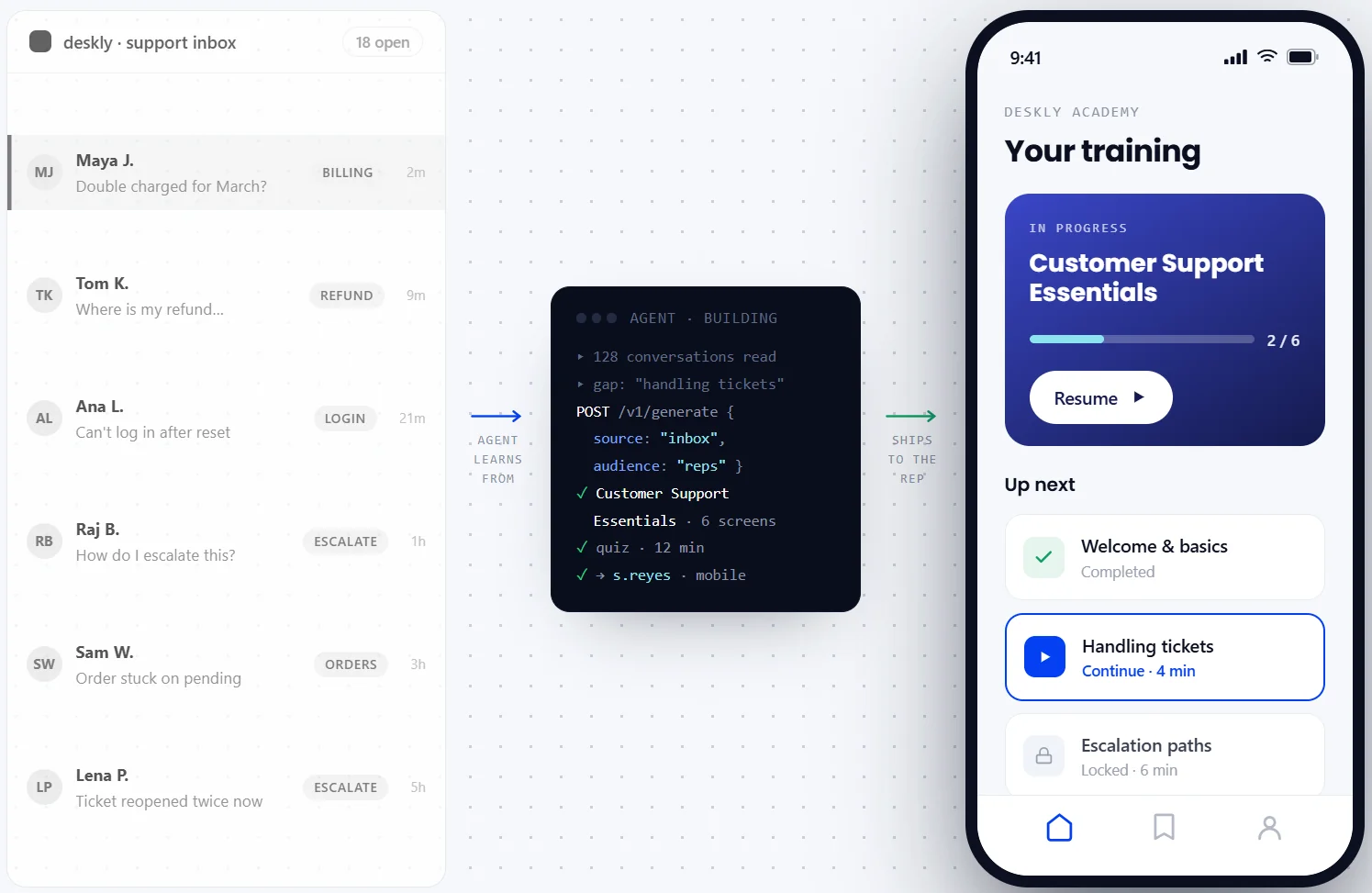
Training can appear inside a customer portal, HR system, or support tool. Your product controls where lessons appear and which users can access them.
For example, a support agent could open a troubleshooting course within the support tool before handling an unfamiliar issue.
Courses generated with AI or built by hand
The same infrastructure can support manually authored courses and AI-assisted creation, depending on its capabilities. AI can draft lessons from product documentation, while authors refine explanations and assessments.
Both approaches need review and clear ownership for keeping content current.
Coassemble illustrates this model with AI-assisted authoring, embedded course delivery, and tracking connected to customers' own systems.
Every completion proven through one API
A shared API can report course completions from embedded learning experiences to your existing systems. Your customer success team could see who completed onboarding in its customer dashboard, without checking a separate training report.
Why is learning infrastructure changing now?
AI agents and Model Context Protocol (MCP) are making API-based training easier to use through conversational tools. An agent can call supported learning functions, such as course creation, when the connection and permissions allow it. This makes training easier to combine with the tools and context teams already use.
AI agents and MCP made training a capability
"If an agent can do the work through an API, then the work is clearly a capability," writes Ryan Macpherson. Those capabilities, he argues, can work across tools and draw on richer context.
APIs already made this possible. MCP gives AI agents a standard way to discover and call supported learning tools.
An assistant could use approved documentation to generate a course through a connected service, ready for human review. Our guide to learning platforms that support AI agents or MCP explains how this works.
Seeing it work makes the idea click
"An API for learning" can feel abstract until you see it in action. Ryan points to two examples: an assistant building a real course inside a product, and a course working inside a support tool.
The first shows course creation as a capability another tool can call. The second shows learning delivered within an existing workflow. Together, they make learning as infrastructure easier to picture.
Where learning infrastructure goes next
Ryan spent three years describing the approach as headless, embedded learning, knowledge transfer, and eventually Embed. Each term still needed explaining. He credits AI agents and MCP with making the idea concrete: people could finally see learning capabilities working inside other tools.
Make learning part of what you build
Learning infrastructure gives product teams more control over how training fits into their software. The core jobs remain: create useful content, deliver it securely, and track what happens.
The opportunity is to make those capabilities serve the user's next task. Start there, and training can become a natural part of using your product.
FAQs: Learning infrastructure
Is a learning infrastructure the same as an LMS?
No. An LMS manages courses and learners. Learning infrastructure includes the systems, components, and processes supporting training, which may include an LMS.
What's the difference between a learning infrastructure and a learning ecosystem?
A learning ecosystem includes people, content, tools, and culture. Learning infrastructure provides the systems and capabilities that support learning within that ecosystem.
Is learning infrastructure the same as a headless LMS?
No. A headless LMS exposes learning functions through APIs without requiring a fixed learner interface. It can form part of your learning infrastructure.
Is learning infrastructure related to machine learning infrastructure?
They describe different things. Here, learning infrastructure supports human learning at work. Machine learning infrastructure supports developing, training, and running AI models.
Do you need to replace your LMS to modernize your learning infrastructure?
Not necessarily. You can connect existing systems or add embedded learning components. Your options depend on your LMS's capabilities, available integrations, and product requirements.
Can small teams have a learning infrastructure?
Yes. A small team's setup might combine an authoring tool, course delivery, and basic tracking. The scope depends on what learners need and which systems the team already uses.
Keep reading
What is the best embeddable training software for SaaS platforms?
Embeddable training software puts course creation, delivery, and tracking inside your product instead of a separate portal. Here's what to look for, and how the top SaaS options compare in 2026.
What training software has the best API and developer documentation?
A robust API means little if the docs are unclear or support-gated. Six practical checks for evaluating a training platform's API and developer documentation before a sales call.
What Is a Learning Experience Platform (LXP)?
Most articles on learning experience platforms are written for people who already run a mature training program. This one is for someone who's just been handed a knowledge problem to solve, fast. Here's what a learning experience platform is, how it fits next to an LMS, its key features, and the examples worth knowing — so you can tell whether an LXP is the right fit for your team.