Microlearning Trends 2026: What's Really Changing
The microlearning trends shaping 2026 all point to the same shift: short, focused lessons are replacing long courses because they finally fit inside busy schedules. But the real story isn't just length — it's who gets to build the training in the first place. Here are the five shifts driving the numbers this year, and what they mean for teams under pressure to move fast.
Microlearning trends in 2026 all point to the same shift: short, focused lessons are replacing long courses because they finally fit inside busy schedules. But the real story isn't just length. It's who gets to build the training in the first place.
Several trends are reshaping corporate training and workplace learning this year. Some are about how content gets personalized to the learner. Others are about who owns the tooling. Product teams are increasingly building their own training experiences directly into the tools they already run, instead of asking employees to log into yet another platform.
This piece breaks down what's driving those shifts, and what they mean for teams under pressure to move fast.
What are the biggest microlearning trends for 2026?
Five shifts are driving the numbers this year:
- API-first, build-your-own training
- AI-powered personalization
- Performance-tied measurement
- Nano-learning
- AI-assisted content creation
Each one depends on training fitting the team's own systems, not asking learners to adopt a separate platform.
The pressure behind this shift is measurable. According to Docebo, 56% of workers are so buried in pre-AI tasks they have no time to learn new tools in the first place. Short, focused lessons are becoming the only format that realistically fits. (What is microlearning? covers the format itself in more depth.)
1. API-first: teams are building their own microlearning instead of buying it
Half the workforce says there's no time for training. Some product teams are solving that differently: not by buying a bigger platform, but by building their own training layer from parts that already exist.
Gartner forecasted that 70% of new applications built by organizations will use low-code or no-code tools — up from less than 25% in 2020. Fewer teams are writing software from scratch, and training tools are following the same pattern.
Instead of adopting one fixed system, teams assemble a course player, a builder, and an analytics view as separate, modular pieces:
- A course player dropped into an onboarding flow inside your product
- A course builder embedded so users create training without leaving your app
- Course or user analytics surfaced inside your own dashboard
Coassemble Embed works this way. Its embeddable components drop into an existing interface one at a time, so a team can start small and add pieces as they need them.
2. AI-powered personalization is replacing fixed content libraries
Building your own training layer is one shift. Deciding what that training actually shows each person is another.
Learning has always relied on shared content libraries, and for good reason. But teams are now adding a layer on top: AI that adjusts what each person sees.
Skillsoft reported that usage of its AI-powered, conversation-based learning tool grew 146% year over year. Platforms are building on that shift, using AI to suggest content based on role, skill gaps, and behavior — working alongside existing systems rather than instead of them.
This pairs especially well with microlearning, since short, single-objective lessons are easy to route to the right person as the system learns what they need:
- A support rep struggling with a specific product feature gets a short, targeted lesson
- A new sales hire skips content they've already mastered
- A manager preparing for a tough conversation gets a two-minute scenario instead of a full workshop
This is adaptive learning in practice. It's less about replacing instructional design and more about routing the right lesson to the right person, at the right moment.
3. Microlearning is being measured by performance, not completion
Personalizing content is one problem. Proving it actually worked is the next one.
Completion rates used to be the main metric L&D teams tracked. That's changing fast — completion alone says nothing about training effectiveness.
According to ATD and the ROI Institute, only 8% of organizations measure the actual business impact of their training. That gap is exactly what's driving the shift toward performance-based measurement.
The real question now is whether training changed behavior and moved business outcomes. Did the new hire actually follow the updated process? Did the support team's response time improve after the product update rolled out?
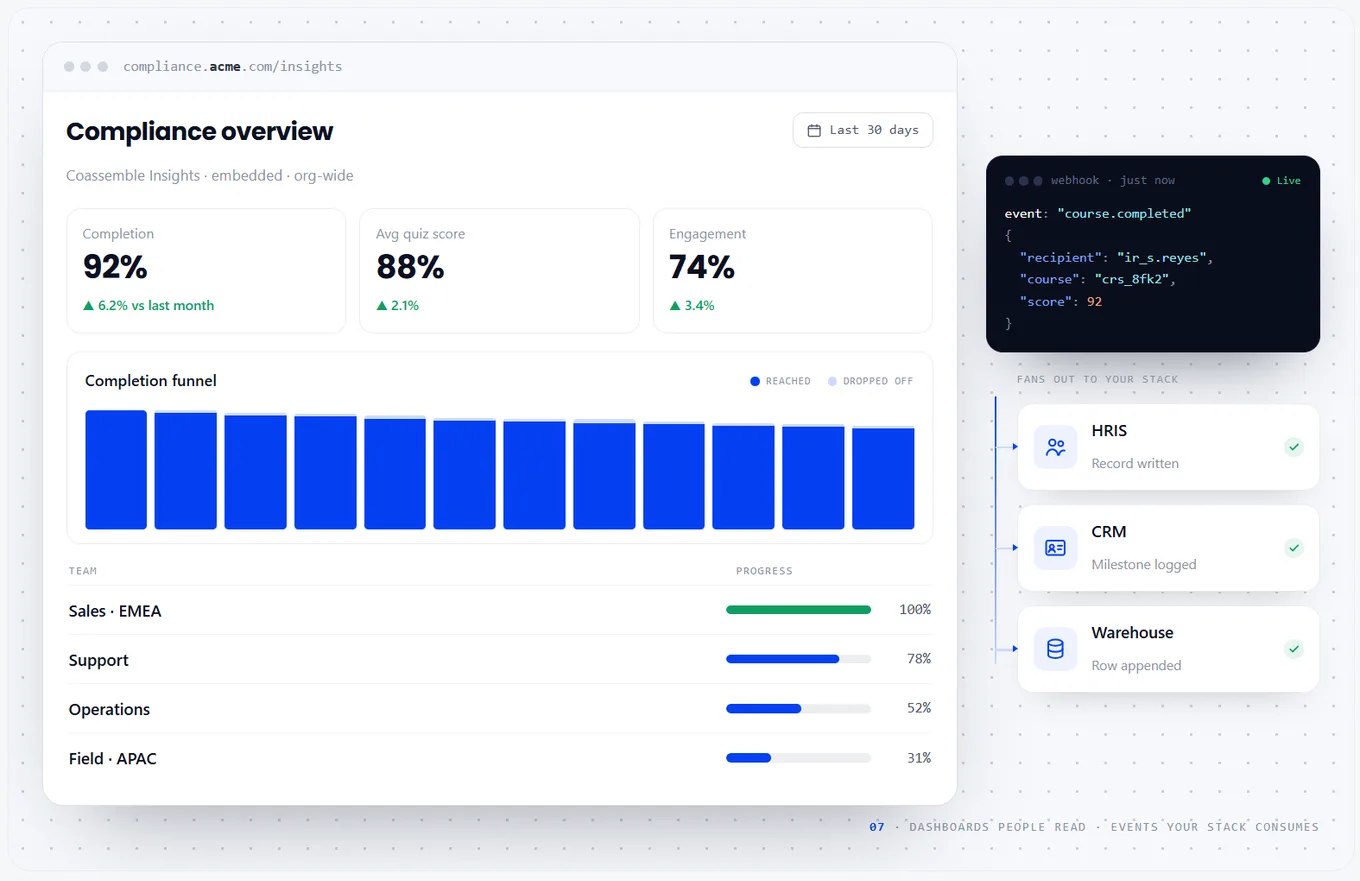
This shift toward performance data requires training that generates real usage signals, not just a checkbox at the end of a module:
- Tracking who opened a document tells you little
- Tracking progress, quiz scores, and completion tells you more
- Connecting that engagement back to a business outcome — like faster ticket resolution or fewer errors — tells you whether the training actually worked
Every Coassemble plan includes an Analytics embeddable that surfaces this data in your own dashboard. On higher-tier plans, teams can also pull it directly via the Tracking API, so a product owner can connect completion, progress, and quiz data to whatever system they already report through.
4. Nano-learning and micro-nudges are gaining ground
Performance data answers whether training worked. It says nothing about how much of it people actually remember.
Alongside longer microlearning modules, even smaller formats are emerging. Nano-learning delivers a single concept in one to three minutes, often as a quick nudge rather than a full lesson.
For example, a product ops lead gets a two-minute nudge the moment a new API rate limit ships: "Rate limits changed for tier 2 accounts — don't quote the old numbers to customers." One idea, delivered exactly when it's needed.
This isn't just a delivery preference. A pharmacy education study found that spaced repetition interrupts the natural forgetting process: learners typically lose 40% of new information within days, and nearly 90% within a month, without reinforcement.
A missed compliance step might trigger a 30-second refresher. A recurring support question might prompt a short, targeted tip the next time it comes up.
- Nudges reinforce key concepts without pulling anyone out of their day
- They work as contextual prompts tied to a specific task, not a scheduled session
- Spacing these moments out fights the forgetting curve better than one long training event
This format works precisely because it respects modern learners' attention. It delivers just enough, exactly when it's needed, instead of asking someone to sit through unrelated material to find the one thing that's relevant.
5. How AI is changing microlearning content creation in 2026
Forgetting is one problem nano-learning solves. Producing all these smaller lessons fast enough is the next.
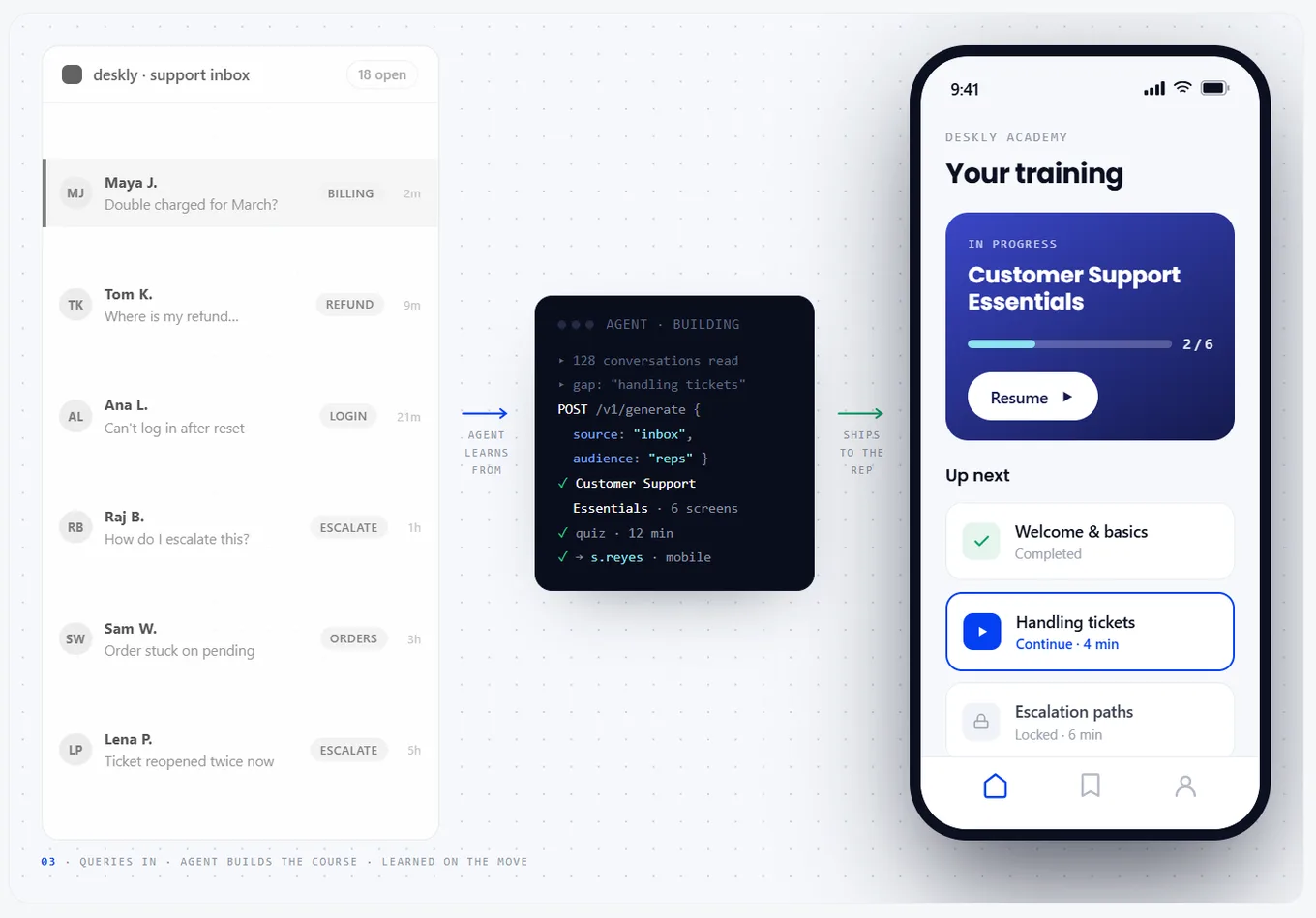
AI is cutting the time it takes to design training content, largely by converting existing documents into structured micro-modules. This means any team — not just instructional designers — can turn what they already know into shareable training.
According to Synthesia, 88% of L&D teams already report saving time on content creation with AI. That time-saving is quickly becoming the baseline expectation; teams now want AI to prove a clearer business impact next.
Anyone can convert a document into a module, not just instructional designers
Turning a process document into training used to require instructional design skills or a long back-and-forth with an outside specialist. That bottleneck is disappearing.
AI can now take an existing document or a recorded call and restructure it into a short, focused lesson. A product ops lead can turn their own process notes into training without waiting on a dedicated content team:
- A support lead can convert a troubleshooting doc into an interactive module the same day
- A sales manager can turn a call recording into a short scenario for the rest of the team
- An HR lead can rebuild onboarding content directly from existing policy documents
This matters for turning existing content into training, since the goal isn't to dump information into a template. It's to restructure it so it's actually usable.
AI shortens design time, but the source material still does the real work
Speed is the obvious win. The risk is that faster content becomes generic, stripped of the context that made it useful in the first place.
According to Fuel50, 38% of HR leaders name trust in AI output quality as the top barrier to scaling AI in their organization. That concern points to a real pattern: content built from a generic prompt tends to read that way.
The strongest workflows use existing material as the source, not a blank prompt. Starting from a real document or a genuine support ticket keeps the details specific to the team using it. A generic lesson about "handling objections" is far less useful than one built from an actual sales team's actual objections.
- Structure and pacing improve retention more than shorter word counts alone
- Interactive elements, like short quizzes, keep the lesson active instead of passive
- Human review still matters, especially for anything customer-facing or compliance-related
Speed and quality aren't actually in tension here. The teams getting the most out of AI content creation are the ones using it to remove busywork, not judgment.
What this means for your team
These microlearning trends aren't asking teams to build more content. They're asking teams to stop treating training like something they have to buy off the shelf.
Corporate training works best when it's infrastructure a product team controls, not a separate platform layered on top.
Coassemble is built for exactly that. As an API-first training platform, it gives teams a course player, a builder, and analytics as separate components — each one drops into an existing product one at a time.
If you're weighing whether to build this yourselves or embed it, here's a practical walkthrough of what that looks like.
Your team already has the knowledge. The only work left is deciding where it should live.
Request a sandbox → and see how it fits into what you're already building.
FAQs: microlearning trends 2026
What are the top microlearning trends?
AI-powered personalization, API-first build-your-own training, performance-based measurement, nano-learning, and AI-assisted content creation are the top microlearning trends for 2026 — all driven by shorter, more targeted training.
Is microlearning still relevant in 2026?
Yes. Microlearning trends show a shift toward continuous, on-demand learning tied to real performance data, not just shorter content. It remains one of the most effective formats for corporate training and skill development.
How is AI used in microlearning?
AI supports personalized learning by suggesting content based on role and skill gaps. It also converts existing documents into structured lessons, cutting content creation time while keeping training specific to each team.
How can I embed microlearning into my own product or platform?
Coassemble Embed gives product teams a course player, builder, and analytics as separate API-driven components. Drop one into your product to start, then add pieces as your training needs grow.
Keep reading
What is the best embeddable training software for SaaS platforms?
Embeddable training software puts course creation, delivery, and tracking inside your product instead of a separate portal. Here's what to look for, and how the top SaaS options compare in 2026.
What is a learning infrastructure, and how is it changing?
Learning infrastructure is the systems that create, deliver, and track training. Here's what it includes, how it differs from an LMS or a learning ecosystem, and how embedded learning and AI agents are changing the model.
What training software has the best API and developer documentation?
A robust API means little if the docs are unclear or support-gated. Six practical checks for evaluating a training platform's API and developer documentation before a sales call.